

BMW builds some of the most rewarding cars on the road, and it charges for that
privilege long after you drive off the lot. If you are shopping for your first BMW,
moving up to a newer model, or trying to budget for the one already in your garage,
the honest question is not whether a BMW costs more to maintain. It is
how much more, on which model, and at what point in the car’s life.
Direct Answer
BMW owners spend roughly $950 to $1,200 per year on average for maintenance and
repairs, compared with about $650 per year across all vehicle brands. Costs are
near zero during the first three years under BMW Ultimate Care, climb to roughly
$1,000–$1,700 per year between years four and six, and commonly reach
$1,500–$2,500 per year from year seven onward as electronics, cooling and
suspension components age. SUVs and M models sit at the top of every range; the 3 Series
and X1 sit at the bottom. Every figure on this page is an average range, not a
quote — actual cost depends on your model, engine, part numbers, mileage and location.
Below we break down what BMW’s service schedule actually asks for, what routine services
and common repairs tend to run nationally, which models are cheapest and most expensive to
keep, and the handful of decisions that genuinely move your annual number.
Is BMW Maintenance Expensive?
Yes — measurably, and by a margin that surprises most first-time owners.
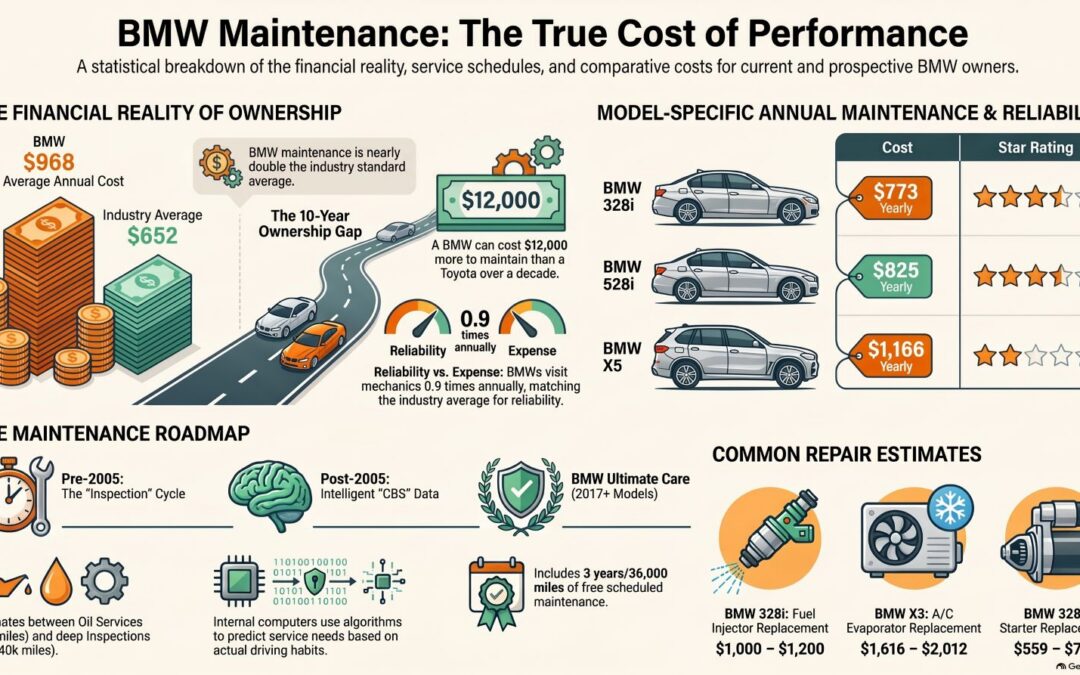
RepairPal puts the average annual repair and maintenance cost for a BMW at about
$968, against roughly $652 across all vehicle brands. That is close to 50% above
the all-brand average, and it lands BMW 30th out of 32 brands in RepairPal’s reliability
ranking, with a 2.5-out-of-5 rating.
Two other numbers matter just as much as the headline figure:
- Shop visits. The average BMW makes roughly 0.9 unscheduled shop
visits per year, compared with about 0.4 across all brands — roughly double. - Severity. About 15% of BMW repairs are classified as severe,
against roughly 12% industry-wide. When a BMW does break, it is somewhat more likely
to be a large job.
Read together, those figures describe the ownership experience accurately: BMWs are not
notably unreliable, but the work they need is more frequent and more expensive
per visit than a mainstream car. Against its direct rivals, though, BMW is not an outlier.
all-brand average, not against other German marques.
How BMW’s Service Schedule Actually Works
BMW has used two different systems, and knowing which one your car uses tells you what
to expect and when.
Mileage-based intervals (most 2005 and earlier models)
Older BMWs alternate between two service types:
- Oil Service — roughly every 8,000–10,000 miles,
depending on how the car is driven. The onboard computer counts the interval down based
on driving style and fuel consumption rather than mileage alone. - Inspection I — around 18,000–20,000 miles. Oil change
plus cabin filter (where fitted) and inspection of brakes, belts, wipers, lights,
battery, charging system and tires, with door seals and hinges lubricated. - Inspection II — around 40,000 miles. Everything in Inspection
I, plus engine air filter, spark plugs, valve adjustment on many M cars, and transmission
service on some models.
On top of that cycle, BMW calls for a brake fluid flush every two years
and a coolant flush every three to four years, regardless of mileage.
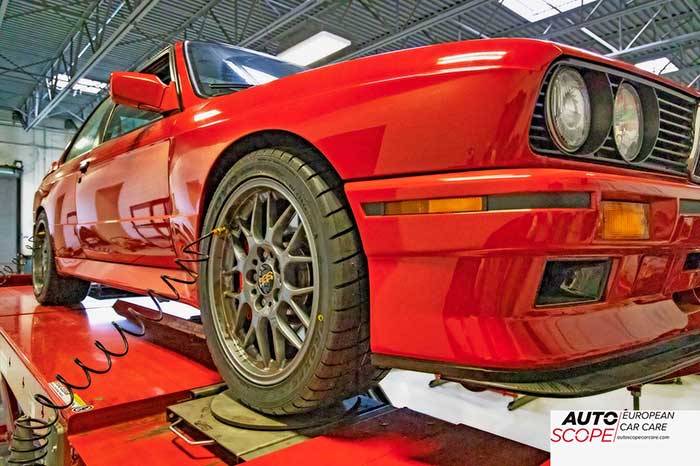
suspension work — and it protects a far more expensive set of tires.
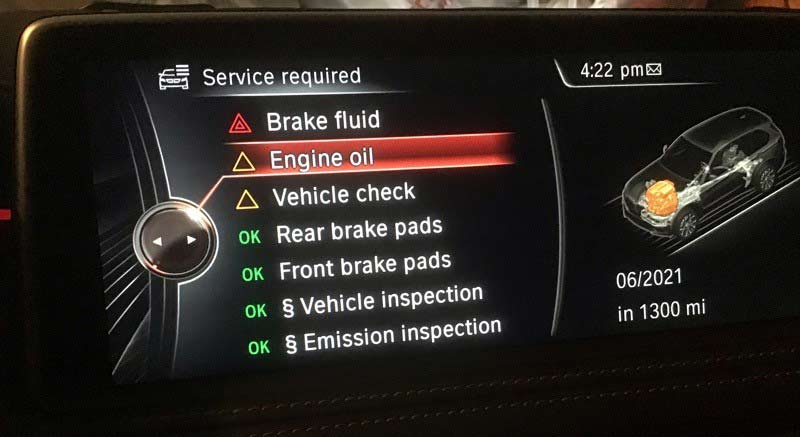
Condition Based Service (2005-and-newer, plus 2002+ 7 Series)
Newer BMWs use CBS — Condition Based Service. Rather than a fixed
calendar, the car tracks fuel consumption, oil temperature, operating hours and, on many
models, actual brake pad thickness via sensors. It then reports each item individually with
its own remaining life.
The practical benefit is that CBS tells you what is genuinely due instead of bundling
everything into a single “40,000-mile service.” It also flags model-specific items —
carbon-ceramic brake condition on certain M cars, clutch and dual-mass flywheel wear on
manual-transmission vehicles. The newest BMWs bundle some items for simplicity: cabin
filters on every second oil service, engine air filter on roughly every third.
If you are comparing quotes, ask which CBS items the shop is reading off the car
and which it is recommending on general principle. That single question separates
a service that is actually due from a service that is merely due someday.
Average Routine Service Costs
The table below shows typical national ranges for common BMW scheduled services.
These are not quotes and not Autoscope pricing — they are published third-party
averages intended to help you budget.
| Scheduled service | Typical interval | Average range |
|---|---|---|
| Oil and filter service (full synthetic) | Per CBS, commonly 7,500–10,000 mi | $150 – $300 |
| Cabin/microfilter replacement | Every 2nd oil service | $70 – $200 |
| Engine air filter replacement | Every ~3rd oil service | $80 – $250 |
| Brake fluid flush | Every 2 years | $130 – $250 |
| Coolant flush | Every 3–4 years | $150 – $350 |
| Spark plugs | ~30,000–60,000 mi (model dependent) | $250 – $700 |
| Brake pads and rotors, per axle | Per CBS wear sensor | $400 – $900 |
| Transmission service | Model dependent | $400 – $900 |
| Four-wheel alignment | As needed / after suspension work | $150 – $300 |
Ranges widen considerably on M models, V8 and V12 cars, and vehicles
with carbon-ceramic brakes or staggered performance tires.
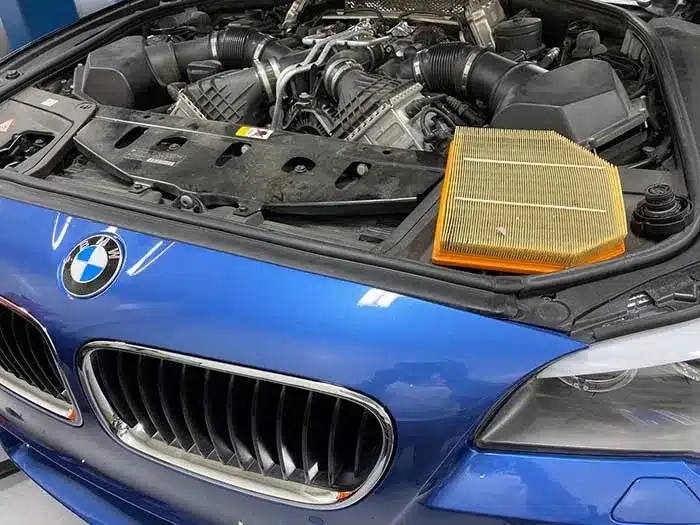
on every second visit, engine air filter on roughly every third.
Average Annual Cost by BMW Model
The brand-wide $968 figure hides a wide spread. Sedans are cheaper than SUVs, SUVs get
more expensive as they get larger, and M cars sit well above everything below.
in M variants, which sit higher still.
Long-term figures follow the same pattern. Third-party estimates put 10-year maintenance
and repair totals for an X1 or X3 in the $18,000–$19,000 range, with
most BMW models landing somewhere between $14,000 and $22,000 over a
decade. M cars can push past $25,000 because of specialized brake compounds, staggered
tires and performance-specific fluids.
Cost is not evenly spread across the years
This is the part most budgets miss. A BMW’s cheapest years and its most expensive years
are not close.
maintenance ends and the wear items begin to come due.
Common BMW Repairs and Average Cost Ranges
Scheduled maintenance is predictable. Repairs are not — they depend on driving
habits, climate, prior service history and a measure of luck. These are the jobs BMW
owners encounter most often, with typical national ranges.
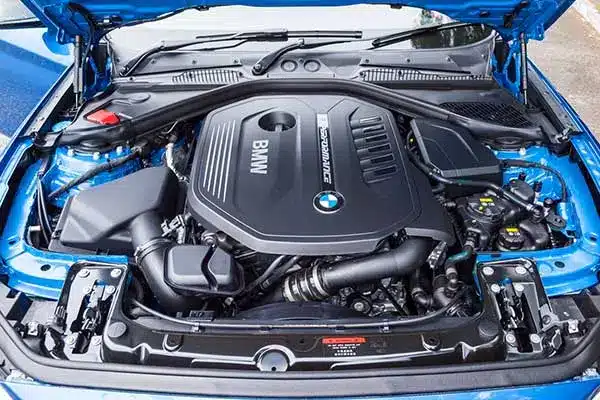
and the cooling system.
| Repair | Why it happens | Average range |
|---|---|---|
| Valve cover gasket | Most common BMW oil leak; gaskets harden after ~60,000–75,000 mi | $400 – $950 |
| Oil filter housing gasket | Second most common leak source; often mistaken for the valve cover | $300 – $900 |
| Water pump and thermostat | Electric pumps are a known wear item on many N- and B-series engines | $700 – $1,500 |
| Oil pan gasket | Labor-heavy on AWD models due to subframe access | $400 – $1,200 |
| Starter replacement | Access varies widely by engine bay layout | $550 – $1,000 |
| Fuel injectors | Direct-injection systems; often replaced as a set | $900 – $1,500 |
| A/C compressor | Frequently accompanied by system flush and receiver/drier | $1,300 – $1,900 |
| Suspension ball joint / control arm | Bushings wear; alignment required afterward | $200 – $700 |
| Window regulator | Common plastic-component failure across many generations | $500 – $850 |
| A/C evaporator | Dash-out labor; one of the most expensive routine-ish jobs | $1,600 – $2,400 |
Notice how many of the top entries are oil leaks. That is not an
accident — leaks from the valve cover, oil filter housing and oil pan are the most
commonly reported BMW problems overall, and they are also the cheapest to fix if caught
early. A seeping gasket found during an oil service is a routine repair. The same gasket
found after it has soaked a belt, contaminated a sensor or starved the engine is not.
progress and discards the data that would have made diagnosis cheaper.
Important: These Are Averages, Not Quotes
Every dollar figure on this page is a published national average or range
compiled from third-party estimator data. It is provided to help you budget and to give you
context when reviewing an estimate. It is not a price quote, and it is not Autoscope
pricing.
Actual cost for your vehicle can vary significantly based on:
- Model, model year and engine — an M340i and a 330i share a
badge family and very little else under the hood - Specific part numbers and supersessions — BMW revises
components mid-generation, and the updated part is often priced differently - Parts choice — OE, OEM or quality aftermarket
- Labor rates in your region — which vary widely by market
- Access labor — the same component can take one hour on one
chassis and six on another - Vehicle condition — mileage, prior repairs, deferred
maintenance and corrosion - Related work — fluids, seals, one-time-use fasteners,
alignment and calibration that the job requires
Prices also change over time as parts costs and labor rates move. Always get a written,
itemized estimate for your specific VIN before authorizing work.
What Actually Drives Your Price
Two owners with the same model year can get very different numbers. Usually it comes
down to four things:
- Diagnosis quality. A confirmed fault costs less than a guessed one.
Replacing parts until a symptom disappears is the most expensive way to fix a BMW. - Timing. Deferred maintenance compounds. A $200 coolant service
skipped for three years is not a saving if it contributes to a $1,400 water pump job. - Bundling. If a repair already requires removing a component, adjacent
work performed at the same time shares that labor. Ask what else is accessible while the
car is apart. - Where the work is done. Dealer labor rates and parts markup are
typically higher than a qualified independent specialist’s, for identical work.
How to Lower Your BMW Maintenance Costs
You cannot make a BMW cost as little as a Camry. You can reliably keep it at the low end
of its own range.

the most expensive.
- Service it when the car asks, not when it is convenient. CBS exists
to catch wear before it becomes damage. Ignoring it is the single most expensive habit
in BMW ownership. - Treat oil leaks as urgent, not cosmetic. They are the most common
BMW problem and the one most likely to escalate into collateral damage. - Do not stretch oil intervals. Modern BMW engines are sensitive to
oil condition, particularly turbocharged variants with timing chains and VANOS systems. - Get a pre-purchase inspection before you buy. On a used BMW this is
the highest-return money you will ever spend.
A thorough PPI
finds deferred maintenance the seller did not mention. - Keep records. Documented service history lowers future diagnostic
time and raises resale value. - Use a specialist with factory-level tools. BMW-specific diagnostic
software shortens diagnosis, and shorter diagnosis is cheaper diagnosis. - Address warning lights promptly. A
check engine light
is information. Driving on it discards that information and lets the underlying fault
progress.
BMW Ultimate Care and What It Covers
New BMWs include BMW Ultimate Care, which covers factory-scheduled
maintenance for the first 3 years or 36,000 miles, whichever comes first.
Roadside assistance runs longer, at four years and unlimited mileage. For model year 2022
and newer, Ultimate Care is transferable to a second owner.
| Covered under Ultimate Care | Not covered |
|---|---|
| Engine oil and filter service | Brake pads and rotors |
| Brake fluid replacement | Tires, wheels, alignment and balancing |
| Vehicle check / inspection service | Wiper blades |
| Remote software updates, where applicable | Battery replacement |
| 1,200-mile running-in service on certain M models | Fluid top-offs, washer fluid, any repair |
Two things worth understanding clearly. First, Ultimate Care is a maintenance
plan, not a warranty — repairs fall under the separate 4-year/50,000-mile
new vehicle limited warranty. Second, the plan follows the car’s CBS logic rather than a
calendar, so two identical cars driven differently will consume their coverage at
different rates. Extended Ultimate Care+ tiers are available and add
wear-and-tear items such as brake pads and wipers.
Coverage terms differ by model year and market and are subject to change.
Confirm your vehicle’s specific coverage in its Service and Warranty booklet or with an
authorized BMW center.
Dealer vs. Independent Specialist
Once Ultimate Care ends, where you service the car becomes a real budget decision.
- Labor rate. Independent specialists generally post lower hourly
rates than franchise dealerships in the same market. - Parts. A qualified independent shop can install original equipment
parts — frequently the same components in different packaging — and can
discuss OE versus OEM versus quality aftermarket where it makes sense. - Tooling. The distinction that matters is not dealer versus
independent. It is whether the shop has factory-level BMW diagnostic equipment and
technicians trained on the platform. Some independents do; many general repair shops
do not. - Warranty. Using an independent shop for maintenance does not void
your factory warranty. Keep documentation of the work performed. - Continuity. A shop that knows your specific car’s history diagnoses
faster on the next visit.
A Note From Autoscope on Pricing
Autoscope publishes this article for informational purposes only. The
figures above are industry averages gathered from public, third-party sources and are
intended to help BMW owners understand general ownership costs and evaluate estimates with
better context. They do not represent pricing at any Autoscope location, and they should
not be relied on as a quote.
Real pricing depends on your specific vehicle. Two cars with the same badge on the trunk
can need different parts, different labor operations and different amounts of time.
If you have a question about a service or a specific repair, please call us or
bring the car in. We are glad to look at your vehicle, confirm what it actually
needs, and give you a custom, itemized quote for your VIN — at either of our
locations. If you are holding an estimate from another shop and want a second opinion,
bring it along with any supporting diagnostic report.
BMW Service in Dallas & Plano
Autoscope European Car Care has specialized in European automobiles for more than four
decades, with factory-level diagnostic equipment and certified technicians at both
locations. Services include
oil and scheduled service,
check engine light diagnostics,
suspension and brakes,
cooling system repair,
transmission service,
electrical and battery work,
pre-purchase inspections and
BMW performance upgrades.
All labor is backed by a 3-year / 36,000-mile warranty.
| Location | Address | Phone |
|---|---|---|
| Plano | 601 Coit Rd, Plano, TX 75075 | (972) 867-7467 |
| Dallas | 9796 Ferguson Rd, Dallas, TX 75228 | (214) 320-8280 |
Schedule in Plano
Schedule in Dallas
When you book, have your VIN, current mileage and a description of the concern ready.
Serving Dallas, Plano, White Rock, Lakewood, Lake Highlands and surrounding DFW communities.
Learn more about
BMW service at Autoscope.
Ask the Experts: What Is BMW Basic Maintenance?
Frequently Asked Questions
How much does BMW maintenance cost per year?
BMW owners average roughly $968 per year across all models, compared with about $652
across all vehicle brands. The realistic range is near $0 during the first three years under
Ultimate Care, about $1,000–$1,700 per year in years four through six, and roughly
$1,500–$2,500 per year from year seven onward.
Which BMW is cheapest to maintain?
Among current models, the 3 Series and X1 are consistently the least expensive, with
average annual figures in the $750–$920 range. Larger SUVs such as the X5 and X6 run
$1,150–$1,250, and M models sit above all of them.
Is a BMW more expensive to maintain than a Mercedes or Audi?
Not meaningfully. Published averages put Mercedes-Benz near $908 and Audi near $987
annually, with BMW between them at roughly $968. The significant gap is between German
luxury brands as a group and mainstream brands, not among them.
How much is a BMW oil change?
A full-synthetic oil and filter service on a BMW typically runs $150–$300 depending
on model, engine and oil capacity. BMW engines require full synthetic oil meeting specific
BMW Longlife approvals, which is why the cost is higher than a conventional oil change.
Do BMWs break down more often than other cars?
BMWs are brought in for unscheduled repairs about 0.9 times a year versus roughly 0.4
across all brands, and about 15% of BMW repairs are classified as severe versus 12%
industry-wide. So they need attention somewhat more often, and those visits tend to cost
more when they happen.
What is the most common BMW repair?
Oil leaks. Valve cover gaskets, oil filter housing gaskets and oil pan gaskets are the
most frequently reported BMW problems, typically appearing after 60,000–75,000 miles.
Caught early they are routine repairs; left alone they can damage belts, sensors and
surrounding components.
Does servicing my BMW at an independent shop void the warranty?
No. You can have scheduled maintenance performed at a qualified independent shop without
voiding the factory warranty, as long as the required services are performed and documented.
Keep your invoices. Note that work covered under Ultimate Care itself must be performed at
an authorized BMW center to be free of charge.
Is an extended BMW maintenance plan worth it?
It depends on your mileage and how long you plan to keep the car. High-mileage drivers
who reach interval limits quickly tend to get more value from prepaid plans; drivers under
roughly 15,000 miles per year often do not. Compare the plan cost against the specific
services it covers for your model rather than against a general average.
Why do BMW repair estimates vary so much between shops?
Labor rate, parts sourcing, how much diagnostic time is included, and whether the
estimate covers required related work such as fluids, seals, single-use fasteners and
alignment. When comparing two quotes, compare the scope line by line before comparing
the totals.
Can I get a quote for my BMW from Autoscope?
Yes. The figures in this article are general industry averages, not Autoscope pricing.
For an accurate, itemized quote on your vehicle, call
(972) 867-7467 (Plano) or
(214) 320-8280 (Dallas), or
book an appointment online
and bring the car in.
Sources
- RepairPal, “BMW Reliability Ratings,” accessed September 2026. repairpal.com
- RepairPal, “BMW X3 Reliability Ratings,” accessed September 2026. repairpal.com
- BMW of North America, “BMW Ultimate Care,” accessed September 2026. bmwusa.com
- ConsumerAffairs, “BMW Maintenance: Cost, Plans and Service Schedule,” January 2026. consumeraffairs.com
- CarEdge, BMW model maintenance cost projections, accessed September 2026. caredge.com
Last updated September 2026. Cost figures are averages compiled from
public third-party sources and are subject to change. This article is published for
informational purposes only and does not constitute a price quote from Autoscope.