
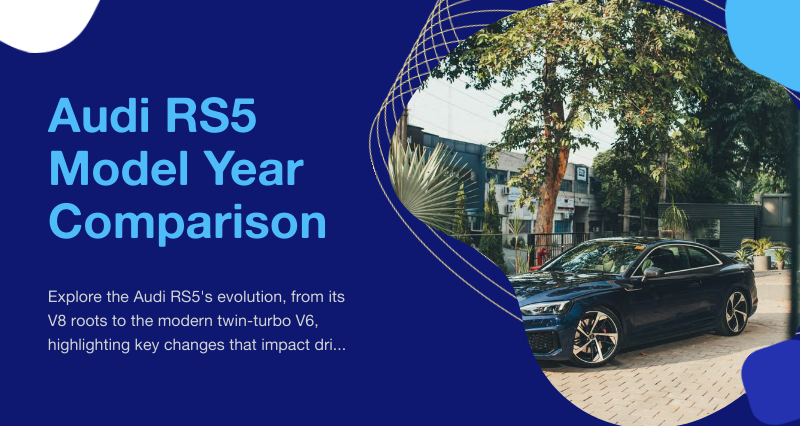
Audi RS5 Model Year Comparison: The Buyer and Owner Guide
The RS5 name spans three fundamentally different cars: the naturally aspirated V8, the twin-turbo B9 and the facelifted B9.5. Model year alone doesn't tell the whole story — generation, body style and installed packages matter just as much.
The Audi RS5 has changed more significantly across generations than its familiar name and exterior styling might suggest. The biggest dividing lines are not annual horsepower increases. They are the move from a naturally aspirated 4.2-liter V8 to a twin-turbo V6, the arrival of the Sportback, the 2021 technology refresh and the Competition package that changed how the B9.5 drives.
For U.S. RS5 buyers, the major model-year breakpoints are 2013–2015 for the V8 first generation, 2018 for the twin-turbo B9 Coupe, 2019 for the first RS5 Sportback, 2021 for the B9.5 refresh and MIB 3 infotainment, and 2023 for the Competition package. Later B9.5 cars retain the same 444-hp 2.9-liter V6 while changing equipment, chassis options and technology.
- Generation Timeline
- 2013–2015: The V8 Era
- 2018–2019: B9 and Sportback
- 2021: The B9.5 Refresh
- 2022: Packages Matter
- 2023: The Competition Package
- 2024–2025: Technology and Sportback
- B9 vs. B9.5: What Actually Changed
- Which Model Year Fits Your Priority
- Service: Model Year Is Only Half the Story
- The Next RS5 Is a Different Car
- FAQ
RS5 at a Glance: Every Generation Mapped
The V8 was a higher-revving, naturally aspirated engine with a dual-clutch transmission. The twin-turbo V6 makes significantly more torque, delivers stronger low-end response and uses a traditional automatic — they feel different to drive and require different service approaches.
2013–2015: The Naturally Aspirated V8 Era
The first U.S.-market RS5 is fundamentally different from everything that followed it. Its centerpiece is a 4.2-liter naturally aspirated FSI V8 producing 450 horsepower, paired with a seven-speed S tronic dual-clutch transmission. Both Coupe and Cabriolet versions were offered.
This generation is the clear choice for someone who prioritizes the character of a naturally aspirated V8 over the acceleration, torque delivery and modern technology of later cars. It is also old enough that condition, maintenance history and previous Audi repair quality should carry substantial weight when evaluating an individual vehicle. A used RS5 from this era benefits significantly from a thorough pre-purchase inspection before commitment.
The later B9 RS5 did not simply update the V8 formula. Audi changed the powertrain architecture entirely — different engine configuration, different transmission type, different torque character. These are genuinely different cars wearing the same nameplate.
2018–2019: The B9 Changes the Formula and Adds a Body Style
The 2018 RS5 Coupe replaced the V8 with a 2.9-liter twin-turbocharged TFSI V6 producing 444 horsepower and 443 lb-ft of torque. Power travels through an eight-speed Tiptronic automatic — no longer a dual-clutch. Peak horsepower dropped slightly from 450 to 444, yet the new car gained substantially more low-end torque and a quicker 0–60 time of 3.7 seconds.
The 2019 model brought the RS5 Sportback to the U.S. — a five-door fastback body using the same 2.9-liter twin-turbo powertrain, with a 3.8-second 0–60 time. For owners using one vehicle for commuting, passengers and track days, that rear hatch and additional doors may matter more than any single equipment change between adjacent model years.
2021: The B9.5 Refresh — The Most Consequential B9-Era Dividing Line
The 2021 model year brought the most substantial update to the B9-era RS5 without changing its engine. The 2.9-liter twin-turbo V6 continued at 444 horsepower. The major changes were exterior design and the technology platform. Audi revised the Singleframe grille to be wider and flatter, added ventilation-style openings above the grille and redesigned the front air intakes.
Inside, the 2021 RS5 received Audi's MIB 3 infotainment platform with a 10.1-inch touchscreen, replacing the earlier MMI control approach. For owners comparing used B9 models, 2021 is the most consequential dividing line for anything related to interior technology or exterior styling.
Audi revealed the revised RS5 internationally in December 2019, so European coverage sometimes refers to it in a 2020 context. For U.S.-market cars, 2021 is the correct breakpoint. This matters when comparing specifications, used listings or parts compatibility between U.S. and European sources.
B9 vs. B9.5: What Actually Changed
| Feature | B9 · 2018–2020 | B9.5 · 2021+ |
|---|---|---|
| Engine | 2.9L V6 · 444 hp | 2.9L V6 · 444 hp |
| Infotainment | MMI with rotary dial | MIB 3 · 10.1-in touchscreen |
| Front grille | Standard Singleframe | Wider, flatter redesign |
| Air intakes | Original B9 design | Larger redesigned intakes |
| Grille vents | Standard design | Ventilation-style openings above grille |
| Wheel arches | 15 mm wider than A5/S5 | 15 mm wider — unchanged |
| Transmission | 8-speed Tiptronic | 8-speed Tiptronic |
| Drive | quattro AWD | quattro AWD |
2023: The Competition Package Is About Chassis, Not Power
The 2023 Competition package is one of the most meaningful developments of the entire B9 generation because Audi focused on how the RS5 drives rather than its power figure. Engine output remained 444 horsepower and 442 lb-ft. A standard 2023 RS5 and a Competition-equipped 2023 display the same horsepower, yet their suspension, steering, tires and overall setup are substantially different. For suspension and brake service, identifying whether the car has Competition hardware is more useful than simply knowing the model year.
Which RS5 Model Year Fits Your Priority
There is no single model year that represents the best RS5 for every owner. The generations emphasize different qualities — and within the B9, even adjacent model years can represent meaningfully different specifications.
Service: Model Year Is Only Half the Story
RS5 maintenance and repair decisions should account for both model year and factory equipment. The difference is obvious across generations — a 2015 RS5 has a naturally aspirated V8 and seven-speed dual-clutch, while a 2018 RS5 uses a twin-turbo V6 and eight-speed Tiptronic. Those are fundamentally different vehicles. The distinction becomes subtler within the B9 generation, where brake configuration, suspension setup and technology packages can vary significantly between two cars with the same model year.
Before planning significant RS5 maintenance or repairs, it is useful to establish the exact build of the car in the bay:
The Next RS5 Begins a Completely Different Chapter
For existing RS5 owners, that transition makes the model-year boundaries even more meaningful. The V8 first generation, conventional twin-turbo B9/B9.5 and the new electrified RS5 represent three distinctly different approaches to the same nameplate. For RS5 Audi service in Dallas and Plano, accurately identifying the generation and installed performance hardware remains the starting point for diagnosing, maintaining and preserving the vehicle as Audi engineered it.
RS5 Service in Dallas and Plano
Factory-trained technicians with European factory diagnostic tools. Generation-specific service for V8 B8, twin-turbo B9 and B9.5 RS5s — backed by a 3-year/36,000-mile labor warranty.
Audi RS5 Model Year — Frequently Asked Questions
What is the biggest difference between older and newer Audi RS5 models?
The largest mechanical change occurred between the 2015 and 2018 U.S. models. The earlier RS5 used a naturally aspirated 4.2-liter V8 and seven-speed S tronic dual-clutch transmission, while the 2018 RS5 introduced a 2.9-liter twin-turbo V6 and eight-speed Tiptronic automatic.
What year did the Audi RS5 Sportback come out?
The RS5 Sportback arrived in the U.S. for the 2019 model year, combining the RS5's 2.9-liter twin-turbo V6 drivetrain with a five-door fastback body and large rear hatch.
What year did the Audi RS5 receive its facelift?
For the U.S. market, the significant B9.5 refresh arrived for model year 2021 with a revised exterior design — including a wider, flatter Singleframe grille — and the 10.1-inch MIB 3 touchscreen replacing the earlier MMI system. European sources may reference a 2020 date because the car was revealed internationally in December 2019.
Does a newer B9 Audi RS5 have more horsepower?
Not necessarily. Audi maintained a 444-horsepower rating across the B9 and B9.5 RS5 models from 2018 through 2025. Later years focused more heavily on technology, equipment and chassis options — not engine output.
What is special about the 2023 Audi RS5 Competition package?
The Competition package added coilover suspension, sport sway bars, Sport direct steering with a fixed 13.1:1 ratio, Pirelli P Zero Corsa tires, an RS sport exhaust and a 180 mph maximum track-speed limiter. Engine output remained unchanged at 444 horsepower.
Is the Audi RS5 Competition more powerful?
No. The 2023 Competition package retained the standard RS5's 444 horsepower and 442 lb-ft of torque. Its changes focused entirely on chassis behavior, steering response, tires, exhaust sound and related performance hardware — not engine output.
Why does the RS5 model year matter for service?
Different generations use entirely different engines and transmissions — a 2015 and 2018 RS5 require completely different service procedures. Within the B9 generation, individual model years can have different suspension types, brake configurations and technology packages. The VIN and option configuration should be confirmed along with the model year before major service or repairs are planned.
- Audi of America, "2015 Audi A5/S5/RS 5 Press Kit," 2014. media.audiusa.com
- Audi of America, "2018 Audi RS 5 Coupe Press Kit," 2018. media.audiusa.com
- Audi of America, "All-new 2019 Audi RS 5 Sportback Pricing Is Announced," 2018. media.audiusa.com
- Audi of America, "2021 Audi RS 5 Coupe and Sportback: Exterior Design and Technology Updates," 2020. media.audiusa.com
- Audi MediaCenter, "Audi RS 5 Coupé — Revised Model," 2019. audi-mediacenter.com
- Audi of America, "Audi Announces Model Year 2022 Audi Sport Updates," 2021. media.audiusa.com
- Audi of America, "Audi RS 5 Turns Up the Volume, Offering the Most Dynamic Package to Date," 2022. media.audiusa.com
- Audi of America, "Audi Updates 2024 Models With New Standard Features," 2023. media.audiusa.com
- Audi of America, "Audi Updates 2025 Model Lineup With Streamlined Trim Selections," 2024. media.audiusa.com
- Audi MediaCenter, "The New Audi RS 5: High Performance in a Hybrid," 2026. audi-mediacenter.com
- Audi of America, "The New Audi RS 5: High Performance in a Hybrid," 2026. media.audiusa.com