
There was a time when an instrument cluster was a needle, a spring and a handful of wires — simple enough that a shop could swap one in an afternoon without a second thought. That car doesn't exist anymore, at least not from Mercedes-Benz.
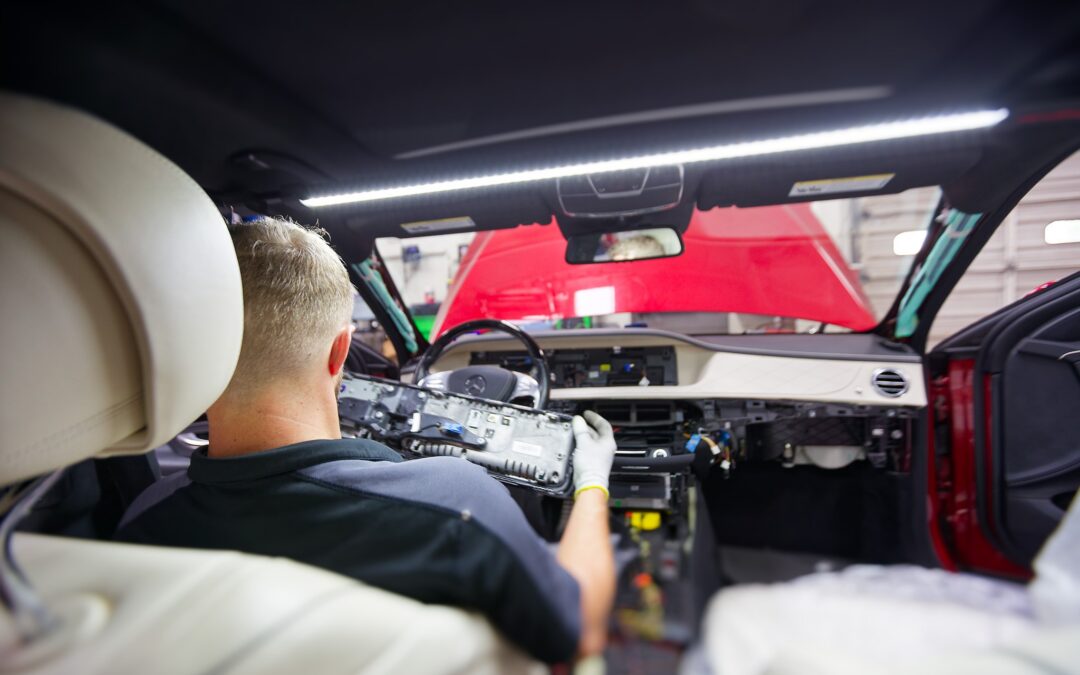
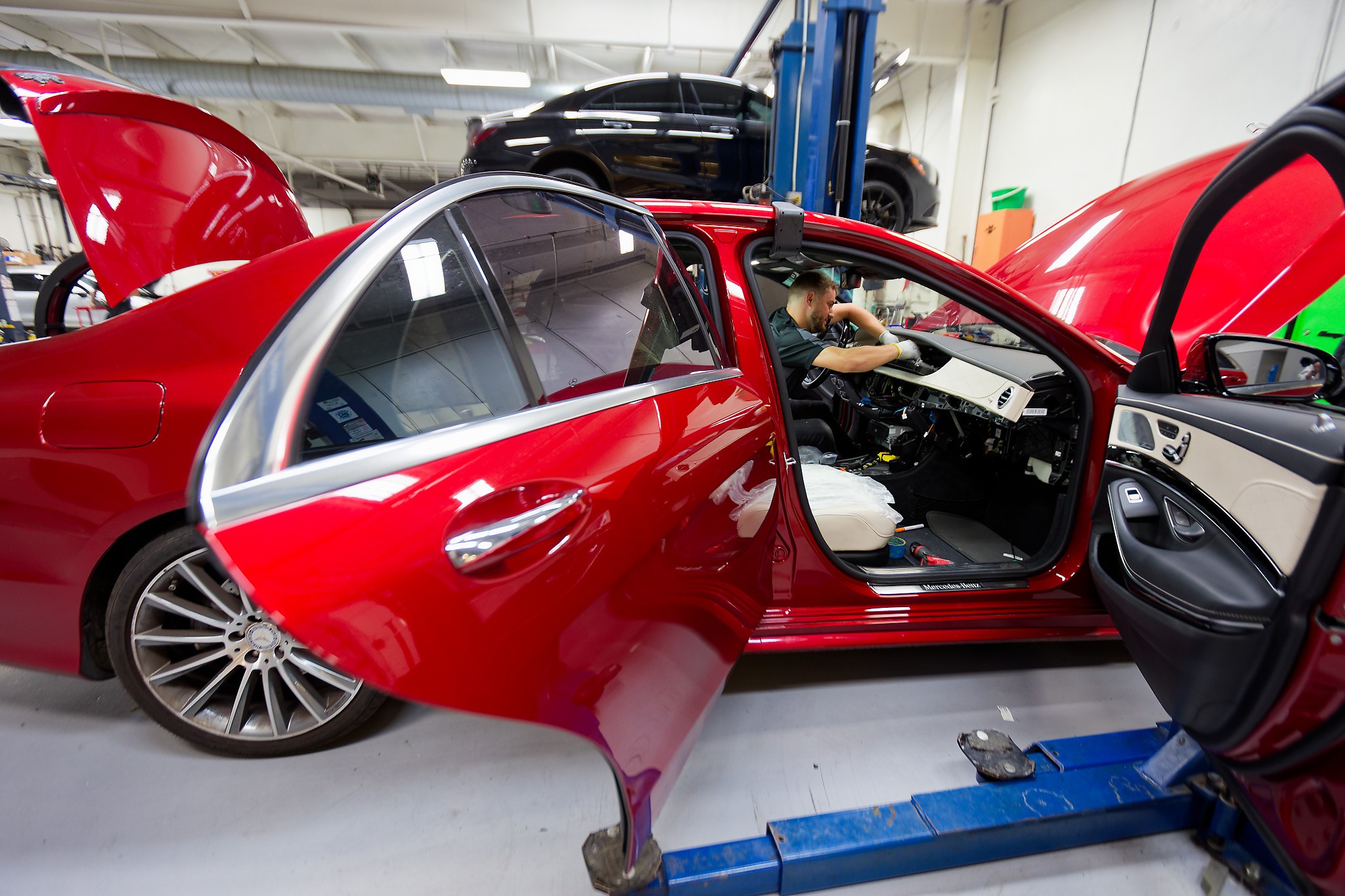
The widescreen digital cockpit in a modern Mercedes is one of the most computationally involved components in the entire vehicle. When it fails, the repair looks nothing like the gauge cluster swaps of even fifteen years ago. We recently took the dash apart on a Mercedes sedan to replace a failed cluster, so we're using that actual job — photos included — to show what's really involved.
A modern Mercedes instrument cluster is a networked computer, not a gauge. A replacement arrives blank and uninitialized, so installing one requires SCN coding to your vehicle's exact configuration, VIN-specific programming, and synchronization with the anti-theft immobilizer — all performed with Mercedes-Benz XENTRY diagnostic software and an active connection to Mercedes' systems. Without that programming, the car may not start, and the odometer typically displays dashes instead of your mileage. The physical removal is real work, but the programming is what turns the new part into a functioning component of your car.
What Is Actually Being Displayed on That One Screen?
What looks like a single sheet of glass is really the meeting point for dozens of separate vehicle systems, all funneled into one display in real time. On a modern Mercedes, that includes:
- Speedometer, tachometer and fuel level — no longer physical gauges, but a live simulation rendered from sensor data traveling across the vehicle's CAN bus network
- Driver assistance status — lane-keeping, adaptive cruise, blind-spot monitoring and collision warnings, all reporting their current state to this display
- Navigation, trip computer and drive mode information layered directly into the driver's line of sight
- Warning and fault messages from nearly every module in the car, since the cluster is the central point where the vehicle "talks" to the driver
- Shared screen real estate with infotainment and climate status on many models, in an integrated widescreen layout
In other words, this one component quietly does the job that used to require a dozen separate analog instruments, warning lamps and switches — simulated, rendered and updated dozens of times per second, without you ever noticing the complexity behind it.

Why You Can't Just Plug In a New One
This is where a modern instrument cluster stops behaving like a normal part. Unlike a mechanical gauge, a replacement cluster arrives as a blank, uninitialized computer. Making it work in your specific car takes real programming, not just a physical connection.
| Step | What it does |
|---|---|
| SCN coding | Programs the cluster with a Software Calibration Number matching your exact vehicle configuration, linking it to your car's specific options and equipment |
| VIN-specific programming | Codes the cluster to your vehicle's VIN — not just its model — which is why a generic replacement can't simply be bolted in |
| Immobilizer synchronization | Syncs the cluster with the anti-theft system. Skip it and the vehicle may not start at all once reinstalled |
| XENTRY diagnostic access | Requires Mercedes-Benz XENTRY software and an active connection to Mercedes' diagnostic systems — the same tools used at the dealership |
| Verification | Confirms every function reports correctly, because a partial coding error can leave some systems working while others silently don't |
Without this step, the car simply won't work correctly. An unprogrammed cluster commonly shows dashes instead of your actual mileage, and critical functions stay disabled until coding is complete.
The detail that catches owners off guard: the labor in this repair isn't only removing and reinstalling a part. It's the programming afterward that makes the new part function as part of your car — rather than an expensive paperweight bolted in behind the steering wheel.
What This Repair Actually Involves
-
Confirm the cluster is actually the problem
A blank or flickering screen, frozen readings, or a cascade of false warning lights can also point to a wiring fault or a module issue elsewhere on the CAN bus. Autoscope's diagnostic process confirms the cluster itself is at fault — not just displaying a symptom of something else — before an expensive replacement part is ordered.
-
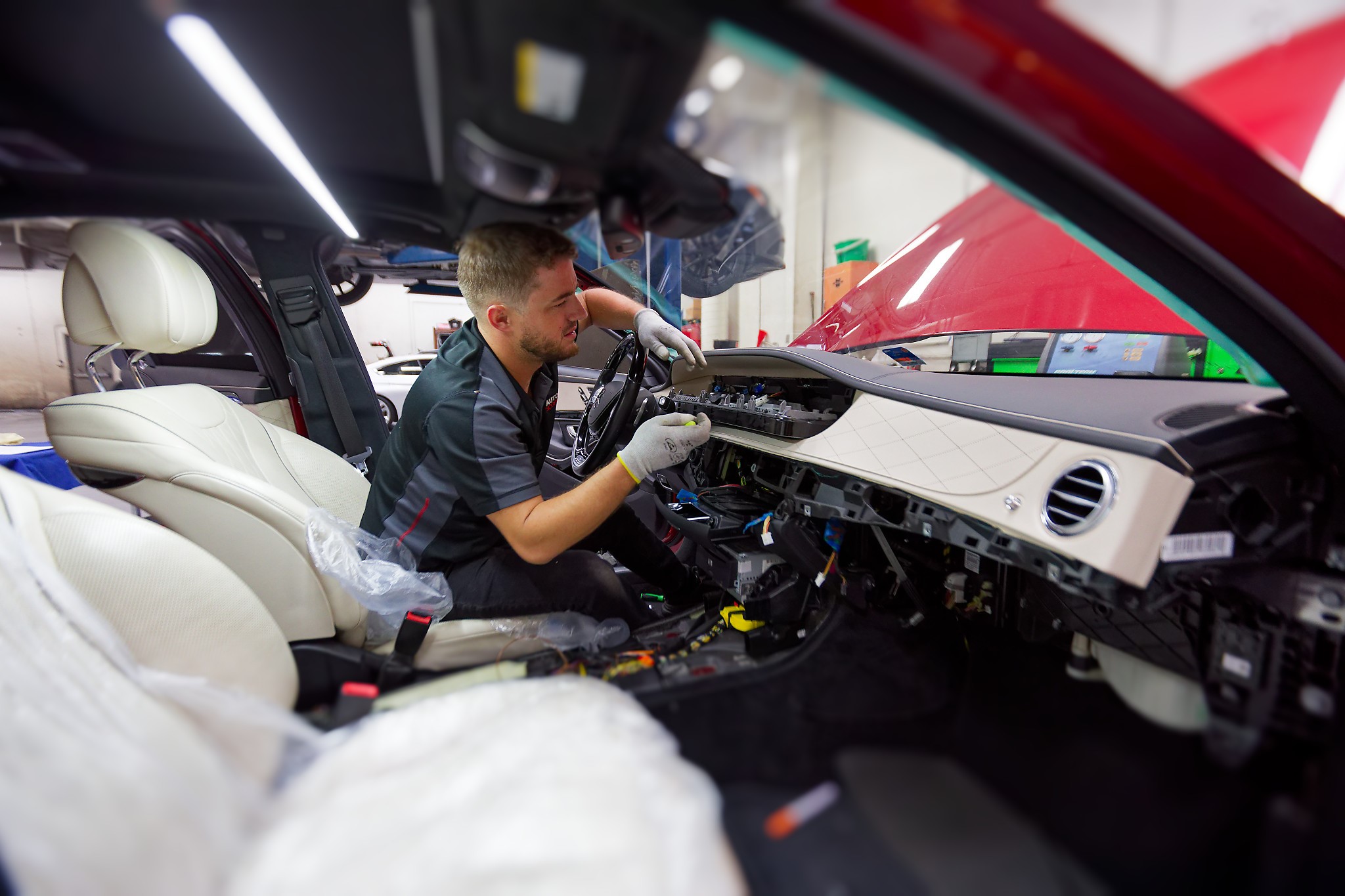
Gain full dash access
Reaching the cluster means partially disassembling the dashboard around the steering column and instrument panel. It isn't a complete dash-out on every model, but it is real disassembly of trim, panels and surrounding structure — as the photographs here show.
-
Remove and handle the cluster carefully
The cluster comes out as a complete module. Every connector and mounting point has to be documented and handled correctly, since these units are both expensive and sensitive to static and impact damage.
-
Perform SCN coding and programming
Once the new or refurbished cluster is installed, it's programmed to the vehicle's VIN and specific equipment configuration using XENTRY, synced with the immobilizer, and verified against the car's actual options — the difference between a finished repair and a part swap.
-
Verify every function
After programming, every system that reports through the cluster gets checked: speed and RPM readings, warning lights, driver assistance status, navigation. A coding error can leave individual functions working while others quietly don't, so this step isn't optional.


Can You Use a Used or Salvage Instrument Cluster?
It's the first question most owners ask once they see the price of a new one, and the answer deserves more nuance than a flat yes or no.
A used cluster is still coded to the VIN and configuration of the car it came out of. Fitting it to a different vehicle means it has to be reprogrammed, and that reprogramming has real constraints: the donor unit's configuration and software level, its stored mileage, and its relationship to the immobilizer all factor in. Mercedes takes odometer integrity seriously, and clusters store mileage data — so a used unit is not a blank slate the way a new one is.
The practical answer is that whether a used or refurbished cluster is viable depends on your specific vehicle, the donor unit and what the diagnostic system will accept. That's a determination to make before buying a part online, not after it arrives.
Signs Your Mercedes Instrument Cluster May Be Failing
This rarely presents as one dramatic failure. It tends to start as a flicker or a dim spot and become less reliable from there.
| Symptom | What it suggests |
|---|---|
| Blank or flickering screen, especially at startup or over bumps | Often the earliest sign — an intermittent internal or connection fault |
| Gauge readings that freeze, jump, or don't match the car's behavior | The display is no longer rendering incoming data reliably |
| Warning lights that don't make sense together, or come and go | Possible false-warning cascade rather than genuine system faults |
| Communication error codes stored in the system ("U-codes") | A network communication problem — which may be the cluster, or may be elsewhere on the CAN bus |
| Odometer or trip computer showing dashes or wrong information | Classic sign of a cluster that isn't properly initialized or is failing internally |
That last row is worth noting for a specific reason: dashes on the odometer are also exactly what an unprogrammed cluster displays. If you're seeing them after someone else already replaced the part, the coding step may simply never have been completed.
What Happens If You Don't Fix It?
Driving on a failed cluster isn't just inconvenient. It removes your visibility into nearly everything the car is trying to tell you.
- You lose the speedometer and fuel gauge, along with any real sense of how fast you're going or how much fuel is left
- Critical warnings may not display at all — low oil pressure, engine overheating, brake system faults — meaning you could be driving with a serious mechanical problem and no visible indication of it
- False warning cascades can appear across multiple systems, making it hard to distinguish a real warning from a cluster glitch
- Driver assistance systems become harder to monitor or trust, even when the underlying systems are still functioning correctly
- Real safety and liability exposure — in most jurisdictions, driving without a working speedometer and warning system isn't legal
That second point is the one worth sitting with. A cluster failure doesn't just hide information about the cluster. It hides information about the engine, the brakes and everything else.
Can You Keep Driving a Mercedes With a Failing Cluster?
Don't drive it
- Screen fully blank or dark
- No speedometer reading
- Warning lights unreadable or nonfunctional
- Vehicle won't start after a cluster was replaced
Schedule promptly
- Intermittent flicker or dim areas
- Readings that freeze or jump
- Warning lights coming and going
- Stored U-codes from a scan
- An estimate you'd like verified
Have it inspected
- Occasional single-pixel or dim spot
- Brief startup glitch that clears
- Service already scheduled
- Pre-purchase inspection
Because this failure is progressive rather than sudden, it's worth addressing as soon as it starts rather than waiting for the screen to go completely dark.
Why the Right Tools Matter for This Repair
Two things determine whether this repair goes well. The first is confirming the cluster is genuinely the failed component rather than the place where another module's problem happens to become visible. The second is having factory-level XENTRY access to code the replacement properly once it's in.
A shop without that access can perform the mechanical half of the job and still leave you with a car that won't start, or an odometer full of dashes. It isn't a shortcut anyone can improvise around — the programming either happens through Mercedes' system or it doesn't happen.
Mercedes Instrument Cluster Replacement in Dallas & Plano
If your Mercedes-Benz has a flickering, blank or unreliable instrument cluster, Autoscope European Car Care has the factory-level XENTRY programming tools and the hands-on experience to diagnose it correctly, replace it, and code it back into your car the right way. We've specialized in European automobiles for more than four decades, with locations serving Mercedes owners across Dallas and Plano, Texas.
Plano — 601 Coit Rd, Plano, TX 75075 · (972) 867-7467Dallas — 9796 Ferguson Rd, Dallas, TX 75228 · (214) 320-8280
Serving Dallas, White Rock, Lakewood, Lake Highlands and surrounding DFW communities.
Backed by a 3-year / 36,000-mile labor warranty.
Frequently Asked Questions
Why does a new Mercedes instrument cluster need programming?
Because it arrives as a blank, uninitialized computer. It has to be given a Software Calibration Number matching your vehicle's configuration, coded to your VIN, and synchronized with the immobilizer before it will function. Until that's done, critical functions stay disabled.
What is SCN coding?
SCN stands for Software Calibration Number. It's the programming step that tells the new cluster which specific options and equipment your car has, so the display matches the vehicle it's installed in rather than a generic version of that model.
Why does my odometer show dashes after a cluster replacement?
That's the classic sign of a cluster that hasn't been programmed. An uninitialized unit doesn't yet hold your vehicle's mileage data, so it displays dashes until coding is completed through Mercedes' XENTRY system.
Can my car fail to start because of the instrument cluster?
Yes. The cluster is synchronized with the anti-theft immobilizer. If a replacement isn't correctly synced, the vehicle may not start even though the cluster is physically installed and the rest of the car is fine.
Can I install a used Mercedes instrument cluster myself?
Physically installing one is possible, but it won't function correctly without programming, and a used unit carries the previous vehicle's coding and stored mileage. Whether a specific donor unit can be reprogrammed for your car depends on its configuration and software level — worth confirming before buying a part online.
Does a generic code reader work for this?
No. This programming requires Mercedes-Benz XENTRY diagnostic software with an active connection to Mercedes' diagnostic systems — the same tooling used at the dealership. A generic scan tool can read fault codes but cannot perform SCN coding or immobilizer synchronization.
Is a flickering screen always the cluster itself?
Not always. A wiring fault or a problem with another module on the CAN bus can produce the same symptoms, which is why the diagnosis needs to be confirmed before an expensive part is ordered.
Where can I get a Mercedes cluster replaced in Dallas or Plano?
Autoscope European Car Care has locations in Plano (601 Coit Rd) and Dallas/White Rock (9796 Ferguson Rd), with factory-level XENTRY programming capability. You can schedule a diagnostic appointment online or call either location directly.