
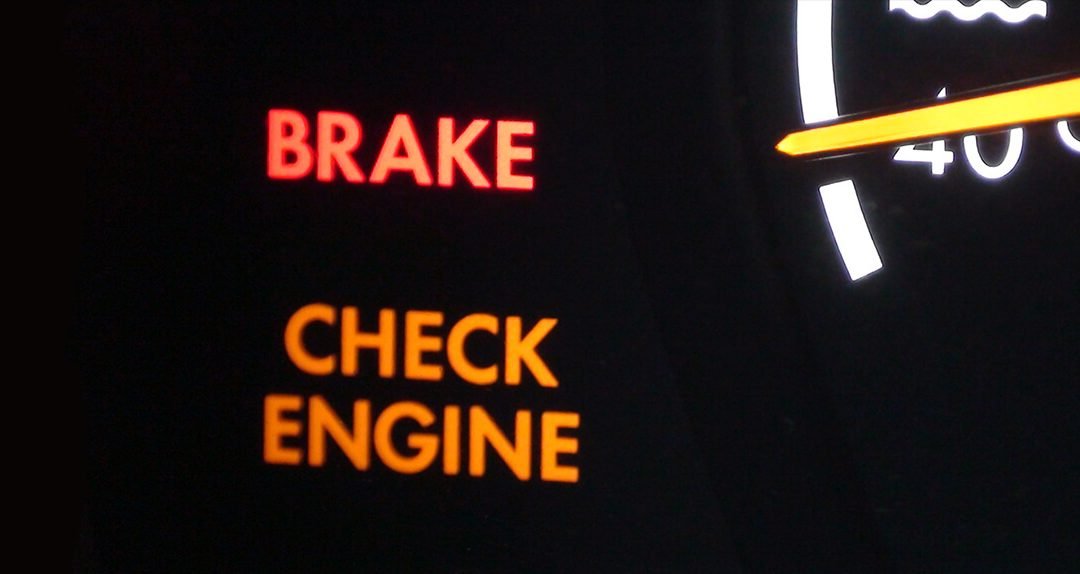
The colour of a telltale is the instruction. The symbol is only the address.
A dashboard warning light is a diagnostic conclusion compressed into a single icon. On a modern European vehicle, that icon is the visible end of a network of thirty or more control modules that monitor one another continuously and report upward. Knowing what dashboard warning lights actually mean — rather than which symbol is which — is often the difference between a sixty-dollar sensor and a four-figure engine repair.
The confusion is reasonable. An Audi, a Range Rover and a Porsche can report the same underlying fault three different ways, and two of the three may not use a symbol at all.
What Dashboard Warning Lights Are Actually Telling You
Every warning light carries two pieces of information at once. The symbol identifies which system reported a fault. The colour identifies how urgently you need to respond. Red means stop driving as soon as it is safe to do so. Amber or yellow means a fault has been recorded, the affected system may be running in a reduced mode, and the vehicle needs diagnosis within days rather than weeks. Green and blue confirm that a feature is switched on and working normally.
That colour hierarchy is not a styling decision made by each manufacturer's design department. Federal safety standards specify the colours of required telltales in vehicles sold in the United States,[1] and the international standard governing control and indicator symbols assigns the same meanings to red, yellow and green across every market.[2] That is why a Mini and a Bentley use identical colour logic despite sharing almost nothing else.
The practical consequence: if you only remember one thing about a light you do not recognise, remember its colour. It tells you what to do in the next sixty seconds. The symbol only tells the technician where to start looking.
Red, Amber, Green: The Severity Code Every Manufacturer Shares
| Colour | What it means | What to do |
|---|---|---|
| Red | Immediate risk to occupant safety or to the engine, brakes or drivetrain. Damage may be accumulating while the light is on. | Pull over as soon as it is safe. Switch the engine off. Arrange a tow rather than a drive. |
| Amber / yellow | A fault is stored. The system may have derated itself to protect other components. The car is usually driveable but is no longer operating as designed. | Drive gently and get the fault codes read within a few days. Avoid long trips and heavy loads. |
| Green | A system is active and functioning — cruise control, lane keeping, hybrid drive. | Nothing. Confirm it is a feature you intended to switch on. |
| Blue | High beams on, and on some diesels a cold-engine or glow-plug status. | Nothing. |
| White / grey | Used by several European brands to show that a driver-assistance feature has been switched off or is temporarily unavailable. | Check whether the deactivation was intentional. A greyed-out feature that will not re-enable is a fault. |
Why Your BMW or Mercedes Shows a Sentence Instead of a Symbol
European manufacturers moved most of their diagnostic communication out of icons and into text years ago. BMW and MINI use Check Control messages in the cluster and on the iDrive screen. Mercedes-Benz shows workshop messages in the instrument display and keeps a separate service menu. Audi and Volkswagen deliver driver messages through the Virtual Cockpit and MMI. Jaguar and Land Rover use a message centre. Porsche pushes alerts through the PCM.
Two things follow from this, and both matter.
First, the generic symbol chart that most owners find when they search covers only a fraction of what these vehicles actually display. A German car is far more likely to tell you Drivetrain Malfunction or Malfunction: Visit Workshop than to light a picture.
Second — and this is the part that costs people money — the message describes a symptom, not a diagnosis. "Drivetrain Malfunction" on a turbocharged BMW can be an ignition coil, a fuel injector, a cracked charge pipe, a failing high-pressure fuel pump or a sticking wastegate actuator. "Restricted Performance" on a Jaguar is a description of what the ECU decided to do, not of what broke. Reading the message as if it names a part is the single most common way owners end up paying for the wrong repair twice.
The same symbol, two different colours
Several European telltales escalate. Coolant temperature and oil condition are the usual examples: the amber stage is a warning that something is out of range, and the red stage means the protection threshold has already been crossed. Owners frequently ignore the amber stage because the car still drives normally — which it does, right up until it does not.
The Warning Lights That Bring European Vehicles Into the Shop Most Often
Oil pressure
This is not a low-oil-level reminder. It reports low oil pressure, which means the pump is no longer delivering oil to the bearings at the required force. Bearing damage begins within seconds and becomes terminal within a minute or two of running. Most European brands show a separate amber message for low oil level, and the two are easy to confuse in the moment — the red can-and-drip symbol is the one that ends the drive.
Common causes on European engines include a failed oil pressure switch or sensor, a sludged pickup screen on a direct-injection engine, timing chain tensioner wear, and oil supply problems in variable valve timing systems. A failed sensor and a failed pump look identical from the driver's seat, which is exactly why the correct response is to shut the engine off and have the car brought in rather than driven in.
Coolant temperature and level
European cooling systems have specific weak points: plastic thermostat housings, electrically driven water pumps, and expansion tanks that develop hairline cracks along the seam. Because most of these vehicles carry a coolant level sensor in the tank, the amber stage usually fires before the temperature moves at all — the car has noticed it is losing coolant, not that it is hot yet.
Aluminium cylinder heads warp quickly once the temperature climbs, and a warped head turns a cooling system repair into an engine repair. One detail worth knowing: on many recent BMW and Mercedes-Benz models the temperature gauge is heavily damped and will sit dead centre through a wide range of real coolant temperatures. Trust the message, not the needle.
Check engine (malfunction indicator lamp)
Every light-duty vehicle sold in the United States since the 1996 model year carries a standardised on-board diagnostics system, and the check engine light is that system's single output.[3] It reports emissions-relevant faults only. A failing air suspension compressor, a worn brake wear sensor or a comfort module fault will never illuminate it.
Steady versus flashing is the distinction that matters. A steady light means a fault is stored and the vehicle should be scanned within a few days. A flashing light means a misfire severe enough to send unburned fuel into the catalytic converter, where it will overheat and destroy the substrate. On a European car, a catalytic converter is among the most expensive emissions components on the vehicle. A flashing light is a red light wearing amber clothing — pull over, shut it down, and have it looked at before the converter is added to the bill. Our check engine light diagnostics start by pulling manufacturer-level data rather than a generic code, for reasons covered below.
EPC — Electronic Power Control
Unique to the Volkswagen Group family, so it appears on Audi, Volkswagen and Bentley vehicles. EPC covers the drive-by-wire throttle system and everything the engine controller consults before granting full throttle authority. It commonly illuminates for throttle body faults, a failed brake light switch, accelerator pedal position sensor problems, or inputs from the ABS and steering angle sensors that the ECU treats as unreliable.
Because EPC is not an emissions light, a consumer-grade code reader frequently returns nothing useful. It also usually arrives alongside noticeably reduced power, which turns a merge onto a Texas highway into a genuine safety problem rather than an inconvenience.
Brake system versus brake pad wear
These are different lights and people routinely conflate them. The red circle-and-exclamation symbol reports the hydraulic system: low fluid, a pressure fault, or simply the parking brake still engaged. The amber pad-wear symbol is a separate circuit completed when a wear sensor embedded in the pad grinds through and closes.
European vehicles use those disposable wear sensors on most axles, and they are not reusable — fitting new pads with the old sensor leaves the warning on the dash and creates the impression the brake work was not done. On Porsche models with carbon-ceramic discs, wear is assessed differently and the replacement economics are in another category entirely, which makes early attention to the warning worth considerably more.
Battery and charging system
On an older car this light meant the alternator. On a modern European vehicle it often means something else entirely. These cars carry an intelligent battery sensor clamped to the negative terminal that reports state of charge, temperature and health to an energy management module, which then decides how hard the alternator should work.
The practical implication: a replacement battery has to be registered or coded to that module. Skip the step and the car continues charging to the profile of the battery it thinks is still fitted — undercharging the new one, shortening its life dramatically, and often triggering charging-system warnings, start/stop unavailability, and a scatter of unrelated electrical faults across other modules.
Tire pressure monitoring (TPMS)
Federal rules require the system to warn the driver when a tire falls 25 percent or more below the vehicle's recommended cold inflation pressure.[4] Since tire pressure drops roughly one psi for every ten degrees Fahrenheit of temperature loss, the first genuinely cold morning of a North Texas winter reliably sets off a wave of TPMS lights on cars that were fine the week before.
The detail almost nobody knows: a steady TPMS light and a flashing one mean different things. Steady means low pressure. A light that flashes for roughly a minute at startup and then stays on means the monitoring system itself has a fault — usually a sensor whose sealed battery has died after seven to ten years, or a sensor that was never registered to the car after a tire change. Filling the tires will not clear it. On BMW and MINI models fitted with run-flat tires the stiff sidewall hides the feel of a deflating tire, which makes the warning the only meaningful signal you will get.
Amber Warnings That Should Not Wait Until the Weekend
Amber is often read as "handle it when convenient." For a specific set of faults on European vehicles, that reading is expensive.
- A flashing check engine light. Catalyst damage accumulates in minutes, not months. Stop driving.
- EPC with reduced power. Throttle authority is limited by design. Passing and merging are compromised until it is resolved.
- "Restricted Performance" on a Jaguar or Land Rover. The ECU has derated the engine to protect something it has already found. The derate is the response, not the problem.
- Amber coolant or low-coolant messages. A car losing coolant at a known rate is on a schedule toward the red stage. The only question is when.
- Transmission or gearbox warnings. Mechatronic and clutch pack faults in ZF, DSG, S tronic and PDK units escalate quickly, and a unit driven through a fault frequently cannot be repaired the cheap way afterwards.
- Brake pad wear. European pad compounds are designed to run thin, and the wear sensor triggers close to the backing plate. The margin between the warning and rotor damage is smaller than most owners assume.
How Each European Brand Words the Same Problem
| Brand | Where warnings appear | Distinctive terminology |
|---|---|---|
| BMW & MINI | Check Control messages in the cluster and on iDrive | "Drivetrain Malfunction"; Condition Based Service (CBS) counters; two-stage yellow-then-red engine symbol |
| Mercedes-Benz | Instrument display plus a separate service menu | ASSYST PLUS "Service A/B due"; "Malfunction — Visit Workshop"; ESP and BAS alerts; AIRMATIC ride-height messages |
| Audi, Volkswagen & Bentley | Virtual Cockpit and MMI driver messages | EPC; "Start/Stop unavailable"; S tronic and DSG gearbox warnings |
| Porsche | Cluster alerts routed through the PCM | PSM faults; emergency-running (limp) mode; PCCB and pad wear notices; coolant level warnings |
| Jaguar & Land Rover | Message centre | "Restricted Performance"; "Suspension Fault — Normal Height Only"; diesel particulate filter messages |
| Rolls-Royce | Cluster plus rotary controller display | Shares BMW Check Control architecture; air suspension and battery-state messages |
The pattern across all of them: the wording describes what the car has decided to do about a fault. It rarely describes the fault. Owners of a Land Rover reading "Suspension Fault — Normal Height Only" are being told the vehicle has locked itself out of off-road and access heights, which narrows the search to the air suspension system but says nothing about whether the culprit is a compressor, a valve block, a height sensor or a leaking air spring.
What a Check Engine Light Means for a Texas Emissions Inspection
Seventeen Texas counties operate an annual vehicle emissions inspection program, including Dallas, Collin, Denton, Tarrant, Rockwall, Kaufman, Ellis, Johnson and Parker.[5] For any 1996 or newer gasoline vehicle, the test is performed by connecting to the on-board diagnostics port rather than by measuring what comes out of the tailpipe.
Which produces a blunt outcome: an illuminated check engine light is an automatic failure, regardless of how cleanly the engine is actually running. The inspection reads the lamp status directly.
The workaround owners attempt — clearing the code the morning of the test — does not work, and it is worth understanding why. Erasing stored codes also erases the readiness monitors, the self-tests the vehicle runs during normal driving to confirm each emissions subsystem is working. A car presented with incomplete monitors is not passed; it is turned away as untestable. Restoring those monitors requires a specific pattern of driving over a period that is usually measured in days, so the attempt costs more time than fixing the fault would have. Texas ended annual safety inspections for most non-commercial vehicles in 2025, but the emissions requirement in those counties was unaffected.[6]
If a renewal date is approaching and a light is on, the sequence that works is diagnosis, repair, then a drive cycle to set the monitors — in that order, with time built in. Booking ahead of the deadline rather than the week of it is the difference between one visit and two.
Four Assumptions That Turn a Small Repair Into a Large One
The trouble code names the failed part
What actually happensCodes describe measured conditions, not broken components. A lean-running code on a turbocharged BMW four- or six-cylinder is far more often a vacuum leak, a failed PCV diaphragm or a cracked charge pipe than a bad oxygen sensor — but the code text mentions the sensor, so the sensor gets replaced. The code narrows the field. Testing identifies the part.
The light went out, so the problem resolved itself
What actually happensIntermittent faults extinguish the lamp after several consecutive clean drive cycles while retaining the stored code and its freeze-frame data — a snapshot of exactly what the engine was doing at the moment of the fault. That snapshot is often the most useful diagnostic evidence available, and it survives the light going out. A car whose light comes and goes is not intermittently broken; it is continuously broken and intermittently detected.
A service reminder is a warning light
What actually happensBMW's Condition Based Service counters and Mercedes ASSYST PLUS intervals are maintenance schedulers, not fault detectors. They are calculated from mileage, time and driving conditions, and they illuminate whether or not anything is wrong. Two consequences follow: resetting one repairs nothing, and a counter left unreset after service will keep insisting on work that was already performed.
Any competent shop can read the codes
What actually happensA generic OBD-II scanner reads standardised emissions-related powertrain codes. That is all it is required to read. The chassis, body, comfort, suspension and driver-assistance modules — where the majority of European faults actually live — are only reachable with manufacturer-level diagnostic platforms. This is why a shop can honestly report "no codes found" on a car that is displaying a Check Control message: they were looking at the one module that had nothing to say.
Software Is Becoming Part of the Repair
The share of European vehicle faults resolved by a programming session rather than a part continues to climb. Replacing a windshield now requires recalibrating the forward-facing camera behind it. An alignment can require resetting the steering angle sensor before stability control will operate correctly. Module coding after a component swap is no longer optional on most late-model German vehicles, and 48-volt mild-hybrid systems have added a whole class of warnings that have no mechanical equivalent at all. The warning light on the dash is increasingly a report from a software system about another software system — which makes the diagnostic tooling behind the repair matter as much as the wrench work in front of it.
Common Questions About Warning Lights
Can I keep driving with the check engine light on?
If the light is steady and the car drives normally, short local trips are generally acceptable while you arrange a scan within a few days. If the light is flashing, stop driving — a flashing lamp indicates a misfire that damages the catalytic converter within minutes.
Why did my warning light come back a few days after the shop cleared it?
Clearing a code removes the record, not the cause. The light returns as soon as the vehicle re-runs the self-test that detected the fault, which can take anywhere from one drive to several depending on the monitor involved.
Does a warning light always mean an expensive repair?
No. Loose fuel caps, low coolant and cold-weather tire pressure drops are common and inexpensive causes. The risk on European vehicles is different: many systems derate themselves when a fault is stored, so a cheap sensor left unaddressed can cause driveability problems that appear far more serious than the underlying fault.
What does EPC mean on an Audi, Volkswagen or Bentley?
Electronic Power Control — the drive-by-wire throttle system. It illuminates when the engine controller detects a fault in throttle control or in one of the sensor inputs it relies on, including the brake light switch and the accelerator pedal position sensor. Reduced engine power usually accompanies it.
My Mercedes says "Service B due" but nothing feels wrong. Is something broken?
No. ASSYST PLUS is a maintenance scheduler that calculates service intervals from mileage, time and driving conditions. Service A and Service B describe different work packages, not fault severity.
Why does my TPMS light flash before staying on?
A flash at startup followed by a steady light indicates a fault in the monitoring system rather than low pressure — most often a sensor with a depleted internal battery, or a sensor that was not registered to the vehicle after new tires were fitted. Inflating the tires will not clear it.
Will a warning light fail a Texas emissions inspection?
An illuminated check engine light will. The inspection reads lamp status directly from the on-board diagnostics port, so the vehicle fails regardless of actual emissions output. Other warning lights, including ABS and TPMS, do not affect the emissions result.
Sources
- National Highway Traffic Safety Administration. 49 CFR §571.101 — Federal Motor Vehicle Safety Standard No. 101, Controls and Displays. ecfr.gov/current/title-49/section-571.101
- International Organization for Standardization. ISO 2575 — Road vehicles: Symbols for controls, indicators and tell-tales. iso.org/standard/68409.html
- U.S. Environmental Protection Agency. Vehicle On-Board Diagnostics (OBD): Basic Information. epa.gov/state-and-local-transportation
- National Highway Traffic Safety Administration. 49 CFR §571.138 — Federal Motor Vehicle Safety Standard No. 138, Tire Pressure Monitoring Systems. ecfr.gov/current/title-49/section-571.138
- Texas Commission on Environmental Quality. Vehicle Inspection and Maintenance Program. tceq.texas.gov/airquality/mobilesource/vim
- Texas Department of Public Safety. Vehicle Inspection Program. dps.texas.gov/section/vehicle-inspection