
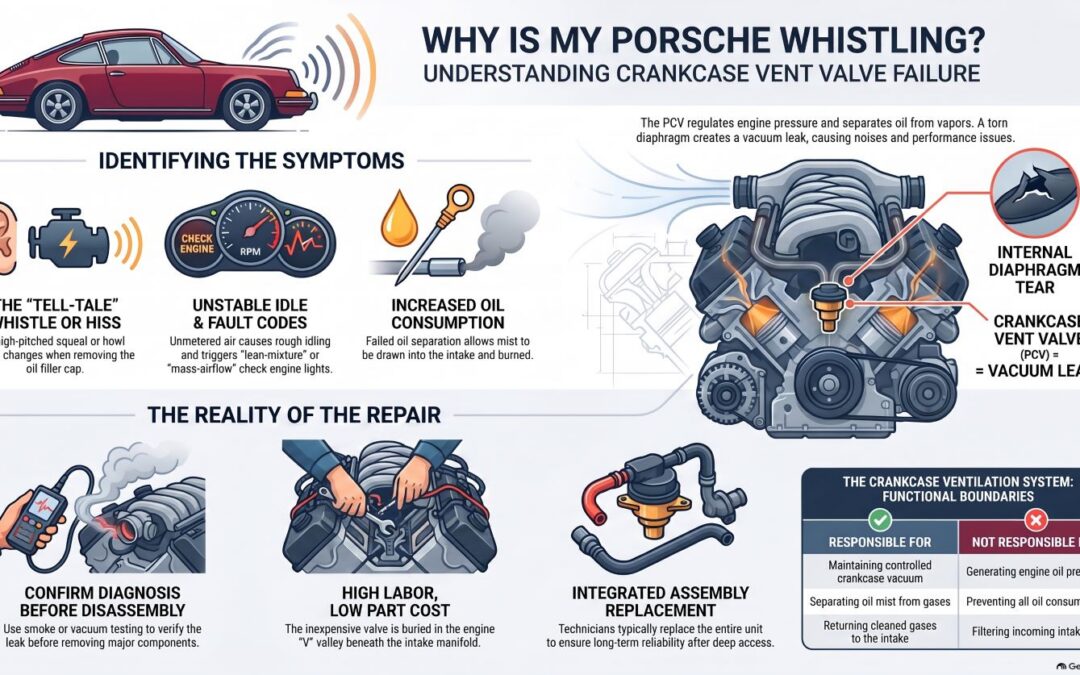
Your Porsche starts making a strange whistle. Maybe the idle turns rough, or the Check Engine Light comes on, or you notice you're adding oil more often than you used to. For a car engineered this carefully, the noise sounds like it must be attached to something enormous.
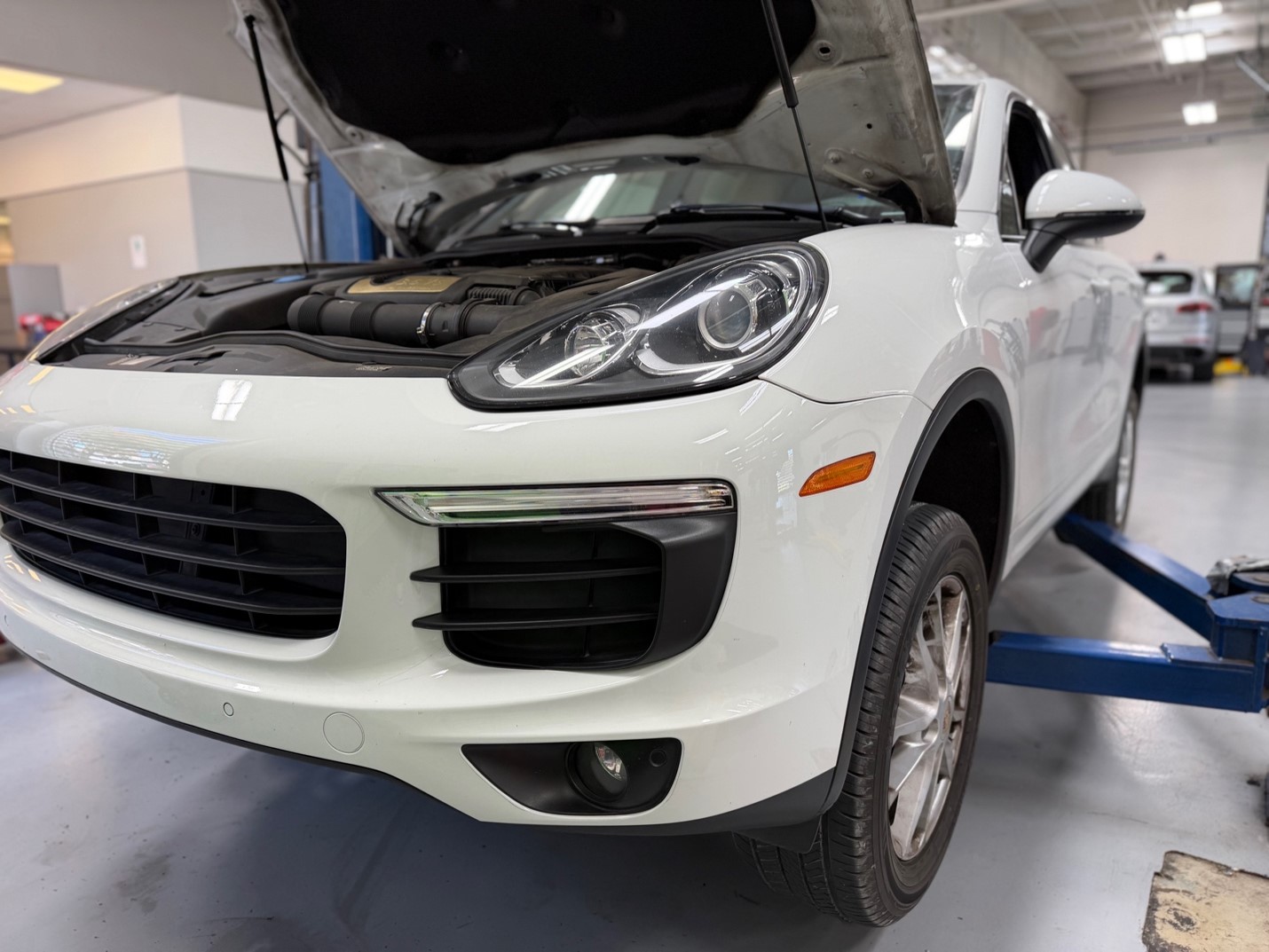
On the Porsche Cayenne shown in the photographs below, the cause was a torn rubber diaphragm inside the crankcase ventilation system — a component that costs a fraction of what the repair does. The part isn't large. Reaching it is another story.
The Porsche crankcase vent valve regulates pressure inside the engine and separates oil from crankcase vapors before those vapors return to the intake. A flexible rubber diaphragm does the regulating. When that diaphragm tears, the controlled crankcase-vacuum system becomes an unmetered vacuum leak — which typically produces a whistling or hissing noise, a rough idle, a Check Engine Light with lean-mixture or mass-airflow faults, and sometimes increased oil consumption. It does not, on its own, mean the engine is damaged. Because the assembly sits in the valley of the V beneath the intake manifold, the correct sequence is to confirm the diagnosis before disassembly begins.
Why Is My Porsche Whistling?
A high-pitched whistle from a Porsche engine bay is very often a vacuum leak, and a torn crankcase vent valve diaphragm is one of the most common sources of that leak.
The diaphragm belongs to the crankcase ventilation system — the system most owners know by its shorthand names, the PCV system or the air-oil separator. Its job is to regulate pressure inside the engine while stripping oil out of crankcase vapors before those vapors are routed back through the intake.
When the diaphragm tears, a carefully controlled crankcase-vacuum system turns into a substantial vacuum leak. Air gets pulled at speed through an opening that was never meant to exist, and the result can be remarkably loud: a whistle, a squeal, sometimes a howl. On many applications the sound changes noticeably when you remove the oil filler cap. In more severe cases, excessive crankcase vacuum can draw air past engine seals and add its own noise on top.
Worth knowing: a whistling engine bay sounds expensive, and the engine underneath is often perfectly healthy. The noise is evidence, not a verdict. What it tells you is that air is entering somewhere the engine-management system isn't accounting for — and that's worth diagnosing rather than living with.
What Does a Porsche Crankcase Ventilation System Do?
Every gasoline engine produces a certain amount of blow-by. During combustion, a small volume of combustion gas inevitably slips past the piston rings and into the crankcase — the lower portion of the engine housing the crankshaft and the engine oil.
Those gases can't be allowed to build pressure inside the engine. They need somewhere to go. Older engines vented them fairly crudely. Modern Porsche engines use a closed, controlled system with three jobs: relieve crankcase pressure, maintain the correct amount of crankcase vacuum, and separate oil droplets out of the gases before those gases return to the intake.
That third job matters more than most owners realize. Crankcase gases carry a fine mist of engine oil, and you don't want all of it drawn straight into the intake and burned. The oil-separation stage pulls out as much as it can while still letting the gases be recirculated. It's elegant engineering — right up until the pressure-regulating diaphragm fails.
| The system is responsible for | The system is not responsible for |
|---|---|
| Relieving pressure created by combustion blow-by | Generating oil pressure for lubrication |
| Holding crankcase vacuum within a controlled range | Sealing the engine on its own |
| Separating oil mist out of crankcase gases | Preventing all oil consumption |
| Returning cleaned gases to the intake | Filtering intake air |
What Is the Crankcase Vent Valve Diaphragm?
Think of the diaphragm as a vacuum regulator. The intake manifold naturally generates vacuum whenever the engine is running. If that vacuum were connected directly and unrestricted to the crankcase, it would pull far too much vacuum inside the engine.
So the diaphragm governs the relationship between intake manifold vacuum, crankcase pressure and ventilation flow. A healthy system holds crankcase pressure inside a narrow window.
When the diaphragm tears, that control disappears. The engine begins pulling air through a path it was never designed to use — and now there's a large internal vacuum leak feeding an engine-management system that has no idea it exists.
What Are the Symptoms of a Failed Porsche Crankcase Vent Valve?
Depending on the engine and the severity of the tear, symptoms range from a noise you'd almost ignore to a car that clearly isn't running right.
| Symptom | What's actually happening |
|---|---|
| High-pitched whistle, squeal or hiss | Air drawn through the torn diaphragm or another unintended path |
| Rough or unstable idle | Unmetered air upsetting the air/fuel calculation |
| Check Engine Light | Stored mixture, mass-airflow or misfire faults |
| Lean-mixture or implausible mass-airflow codes | Measured air no longer matches the air actually entering the engine |
| Misfires | Mixture error, or spark plugs fouled by oil |
| Increased oil consumption | Oil mist pulled into the intake and burned |
| Oil residue inside the intake system | Failed oil separation |
| Blue or white exhaust smoke | Engine burning oil drawn in through the ventilation system |
| Oil filler cap very hard to remove at idle | Excessive crankcase vacuum holding the cap down |
A torn oil-separator diaphragm is a well-documented cause of vacuum leaks, rough idle and mass-airflow plausibility faults on Porsche applications, including diagnoses that traced an audible vacuum leak and a mass-airflow fault directly back to the diaphragm.
The Real Repair: Porsche Cayenne at Autoscope
The Porsche in these photographs is an actual Cayenne repaired at Autoscope European Car Care. These aren't diagrams or stock images — this is what the job looks like as it comes apart.

Why Does the Intake Manifold Have to Come Off?
Because the crankcase ventilation assembly sits deep in the valley of the V, underneath the intake manifold, wiring, vacuum lines and fuel-system components. This is where owners understandably get frustrated: they look up the part, see a modest price, and wonder why the labor figure looks the way it does.


To reach the assembly, a technician may need to remove or reposition intake ducting, intake manifold assemblies, electrical connectors, vacuum lines, fuel-related components, wiring harness sections, brackets, hoses, and the intake seals and gaskets. Then all of it goes back — correctly.


The pattern worth noticing: this is the same story as a Mercedes oil pump control valve or a $20 seal buried behind six hours of disassembly. A small failed component, an expensive path to reach it. Which is exactly why the diagnosis has to be right before the intake manifold comes off, not after.
Why Do Porsche Crankcase Vent Diaphragms Tear?
The diaphragm is a rubber membrane living in one of the least hospitable spots in the engine. Over its life it experiences:
- Continuous engine heat
- Hot oil vapor
- Constant vacuum cycling
- Pressure changes
- Thousands of heating and cooling cycles
- Chemical exposure from crankcase gases
- Normal aging of the rubber itself
Eventually the rubber becomes brittle, weakened or distorted. Then it tears.
Porsche has also documented a specific manufacturing-related cause on certain Cayenne models, in which a burr on the crankcase ventilation valve cover could damage the diaphragm. Porsche's own documentation on that issue describes implausible mass airflow at idle, noises from the engine compartment, and activation of the Check Engine Light — which lines up precisely with what these engines do in the field.
Diaphragm-regulated crankcase ventilation is used across modern European automobiles, so this failure mode isn't unique to Porsche. The packaging and the repair procedure, though, are very Porsche-specific.
Why Does a Failed Diaphragm Cause a Rough Idle?
Modern Porsche engine management is extremely precise about air. The engine computer measures or calculates how much air is entering the engine, then adds a matching amount of fuel.
A torn crankcase vent diaphragm introduces air the system never accounted for. Now the computer sees a mixture that doesn't match its own math. It tries to compensate. Fuel trims move. The idle turns unstable. Eventually the engine stores mixture, mass-airflow or misfire faults.
That's how a small tear in a piece of rubber makes an otherwise healthy Porsche engine run badly.
Can a Failed Porsche Crankcase Vent Valve Cause Oil Consumption?
Yes. Remember what the oil separator is for: pulling oil out of crankcase vapors before those vapors reach the intake. When separation stops working properly, excessive oil mist — or in severe cases liquid oil — gets drawn into the intake and burned.
That can produce increased oil consumption, oil residue in the intake, blue-white exhaust smoke, spark-plug contamination and combustion deposits. Other Porsche air-oil separator applications are well documented for exactly this once the internal diaphragm gives up.
Can a Bad Porsche Crankcase Vent Valve Damage the Engine?
This deserves a more careful answer than it usually gets online. A torn diaphragm does not mean your engine will be destroyed tomorrow. It also isn't something we'd recommend ignoring indefinitely, because operating an engine with incorrect crankcase pressure has consequences that compound.
-
Incorrect air/fuel mixture
A vacuum leak can push the engine outside its intended mixture-correction range, producing rough running, misfires, poor performance and Check Engine Lights. Long-term misfires also put additional stress on catalytic converters — which is how a rubber diaphragm becomes an emissions repair.
-
Excessive oil consumption
If the ventilation system pulls too much oil into the intake, the engine consumes oil faster than normal. The oil is being burned, and the level can quietly fall if the owner doesn't realize what's happening. Running any Porsche low on oil is what we're really trying to avoid here.
-
Oil contamination in the intake
Excess oil vapor or liquid oil coats intake components and, over time, contributes to deposits and contamination throughout the air path.
-
Spark-plug and combustion problems
Oil burning in the combustion chamber fouls spark plugs and contributes to misfires — which loops back to the first item on this list.
-
Excessive crankcase vacuum
The system is supposed to regulate vacuum. More is not better. Abnormally high crankcase vacuum stresses engine seals and can allow air to be drawn past sealing surfaces. Excessive vacuum is a recognized symptom of failed separator and PCV systems.
What About the Engine Seals?
Engine seals are designed to work within a particular pressure range, and sustained excessive crankcase vacuum changes how they behave. Over time you may see oil leaks, air leakage past seals, or additional whistling noises.
That doesn't mean every torn diaphragm leads to a rear main seal problem. It does mean crankcase pressure matters. The ventilation system isn't an emissions afterthought bolted onto the engine — it's part of how the engine was designed to operate.
How Should a Porsche Crankcase Vent Valve Be Diagnosed?
Don't replace the assembly just because the engine whistles. Several different vacuum leaks produce nearly identical symptoms, and the access labor here is significant enough that you want to be confident before anything comes apart.
-
Start with a complete Porsche diagnostic scan
Using Porsche-capable equipment, not a generic code reader. We're looking for mixture adaptation faults, mass-airflow plausibility faults, misfires and idle-control faults — and for the story around them. Is the fault current or stored? How often has it occurred? What do the long-term fuel adaptations show? A code reader tells you a fault exists. Diagnosis determines what caused it.
-
Locate the leak physically
A torn diaphragm often produces a distinct whistle or hiss at idle that can be traced to its source. That's evidence you can act on.
-
Evaluate crankcase vacuum
There should be some crankcase vacuum. There should not be excessive vacuum. One useful indicator on many applications is the oil filler cap: if it's extremely difficult to remove while the engine idles because vacuum is holding it down, the ventilation system isn't regulating properly.
-
Smoke or vacuum testing
Testing separates an actual crankcase-ventilation problem from a different intake-system leak that would produce similar codes and similar noises for a very different repair.
-
Confirm before major disassembly
This is the one that saves money. Look again at the photographs above — you want to know exactly why that intake manifold is coming off before it comes off.
Estimate standard. A useful estimate states what was tested, what failed, why the proposed repair addresses that failure, which parts and fluids will be used, and what warranty applies. "It's whistling, so it needs a vent valve" is not enough information to authorize a repair of this size.
Why Is This Repair So Labor Intensive?
Customers look up the price of the component online and wonder why the repair costs substantially more. The answer is straightforward: you're not paying someone to install the part. You're paying them to reach it.
The sequence runs diagnose, remove intake ducting and manifolds, release electrical and fuel-system components, expose the valley of the engine, remove the failed assembly, install the new one with correct seals, reassemble the intake system, clear faults and verify operation. The diaphragm is tiny. The Porsche around it isn't.
Should the Complete Assembly Be Replaced?
On many Porsche engines the diaphragm is integrated into a larger crankcase ventilation and oil-separation assembly, and the factory repair strategy replaces the complete unit rather than the membrane alone.
Once you've invested the labor required to expose a part buried this deeply, reliability matters. Nobody wants the intake manifold coming back off in six months because an adjacent part of the same tired assembly let go. We don't advocate replacing parts simply because they happen to be nearby — but on an integrated assembly, replacing the whole unit usually is the repair.
Can You Drive a Porsche With a Failed Crankcase Vent Valve?
Often the vehicle stays drivable. That isn't the same as safe to ignore, and severity varies enormously between a faint whistle and an engine pulling oil into the intake.
Stop safely
- Low oil pressure warning
- Oil level warning
- Heavy blue or white smoke
- Severe rough running or misfire
- Any message instructing you to stop
Schedule promptly
- Steady Check Engine Light
- Audible whistle or hiss at idle
- Rough idle that comes and goes
- Oil loss between services
- A large repair estimate you want verified
Plan ahead
- Faint noise, no other symptoms
- Oil change already approaching
- Service reminder due
- Related work worth combining
If there's significant smoke, severe rough running or any oil warning, stop treating it as a minor nuisance and have the vehicle evaluated. The safest approach is to diagnose the failure and understand its severity, rather than guessing based on how the Porsche feels from the driver's seat.
Can the Code Simply Be Cleared?
You can clear almost any fault code. That doesn't mean anything has been repaired. If an active vacuum leak exists, clearing the code removes the evidence temporarily and nothing else. It's resetting a breaker that keeps tripping — eventually you need to find out why it keeps tripping.
Can You Prevent Crankcase Vent Valve Failure?
There's no published Porsche interval telling owners to replace this assembly at a set mileage. But several habits protect the ventilation and lubrication systems as a whole.
| Habit | Why it matters here |
|---|---|
| Use the correct Porsche-approved oil | Modern Porsche engines are designed around specific lubricant requirements. Oil quality affects vapor and deposit formation inside the ventilation passages. |
| Maintain sensible oil-change intervals | Degraded oil produces more vapor and more residue for the separator to handle. |
| Investigate new noises early | A whistle is cheap information. The consequences of ignoring it — misfires, oil consumption, seal stress — are not. |
| Check your oil level between services | Rising consumption is often the first measurable sign that separation has failed. |
| Get a second opinion before major work | Particularly on a repair where most of the cost is access labor. Ask what was tested and how the diagnosis was confirmed. |
Why Porsche Experience Matters
The hard part of a Porsche crankcase ventilation failure isn't replacing the component. It's establishing that the component is genuinely responsible before significant disassembly begins.
So the questions we work through are: Is there excessive crankcase vacuum? Is the diaphragm actually torn? Is unmetered air entering the engine, and from where? Is oil being pulled into the intake? Are there other vacuum leaks contributing? And what do the Porsche fault memories and fuel adaptations actually say?
The objective isn't find noise → replace part. It's verify the complaint, scan the vehicle, test the system, identify the failure, repair it correctly, then verify the repair. When reaching the component requires hours of disassembly, that difference is real money.
Porsche Crankcase Vent Valve Repair in Dallas & Plano
If your Porsche is whistling from the engine compartment, idling rough, showing a Check Engine Light, setting lean-mixture or mass-airflow faults, using more oil than normal or smoking at startup, Autoscope European Car Care can help. We've specialized in European automobiles for more than four decades, with locations serving Porsche owners in Dallas and Plano, Texas. If you've received a large Porsche repair estimate elsewhere, we're happy to provide a second opinion.
Plano — 601 Coit Rd, Plano, TX 75075 · (972) 867-7467Dallas — 9796 Ferguson Rd, Dallas, TX 75228 · (214) 320-8280
Backed by a 3-year / 36,000-mile labor warranty.
Because when a Porsche starts whistling, there's one question worth answering before authorizing any repair: "Are we sure that's where the air is coming from?"
Frequently Asked Questions
What does a Porsche crankcase vent valve do?
It regulates crankcase pressure and vacuum while separating oil from crankcase vapors before those vapors are routed back into the intake system. A flexible rubber diaphragm inside the assembly does the regulating.
How do I know if my Porsche crankcase vent valve is bad?
Common signs are a whistling or hissing noise at idle, a rough idle, a Check Engine Light with lean-mixture or mass-airflow faults, increased oil consumption, and an oil filler cap that is very hard to remove while the engine is running. Confirmation requires a diagnostic scan plus vacuum or smoke testing, because other intake leaks produce similar symptoms.
Why is a Porsche crankcase vent valve replacement so expensive?
The assembly is buried in the valley of the V beneath the intake manifold. Reaching it requires removing intake ducting, intake manifolds, electrical connectors, vacuum lines, fuel-system components and harness sections, then reassembling all of it with new seals. Most of the cost is access labor, not the part.
Can a torn crankcase vent diaphragm cause a Check Engine Light?
Yes. The unmetered air it admits commonly triggers mixture adaptation, implausible mass-airflow and misfire faults. Porsche's own documentation on this failure describes implausible mass airflow at idle, noises from the engine compartment and activation of the Check Engine Light.
Can a bad crankcase vent valve cause my Porsche to burn oil?
It can. When oil separation fails, oil mist or liquid oil is drawn into the intake and burned, which shows up as increased oil consumption, blue-white smoke, oil residue in the intake and fouled spark plugs.
Is it safe to keep driving my Porsche with a bad crankcase vent valve?
Sometimes the car remains drivable with only a mild whistle. But heavy smoke, severe rough running, high oil consumption or any oil warning should be evaluated promptly rather than driven on. The severity needs to be diagnosed, not estimated from how the car feels.
Does a whistling noise always mean the crankcase vent valve?
No. Several intake and vacuum-system leaks produce a similar whistle. That's exactly why smoke or vacuum testing comes before disassembly on this repair — the access labor is too significant to spend on a guess.
Where can I get a Porsche second opinion in Dallas or Plano?
Autoscope European Car Care has locations in Plano (601 Coit Rd) and Dallas/White Rock (9796 Ferguson Rd). If you've been quoted a large crankcase ventilation or air-oil separator repair, we're glad to review the diagnosis and testing behind it.