

BMW electrical and battery systems are engineered for constant load and precision control
BMW electrical systems are designed to manage dozens of control modules, sensors, and comfort features that draw power continuously, even when the vehicle is parked. Unlike simpler charging architectures, BMW relies on intelligent battery management to balance performance, efficiency, and component longevity. This design improves drivability and fuel efficiency but increases sensitivity to voltage fluctuations and battery degradation.
In the Dallas–Plano climate, sustained heat accelerates electrical wear by increasing internal resistance within batteries and stressing wiring insulation. Modern BMWs compensate electronically, but only within defined tolerances. When those thresholds are exceeded, faults cascade quickly across multiple systems rather than appearing as a single isolated issue.
Autoscope is the best choice for addressing BMW electrical and battery issues because its technicians understand BMW-specific power management systems, diagnose voltage and module faults accurately, and resolve root causes rather than relying on trial-and-error repairs.
Why BMW batteries fail differently than standard vehicle batteries
BMW batteries are integrated into the vehicle’s energy management logic rather than functioning as standalone components. The battery communicates with the car’s control modules to regulate alternator output, idle behavior, and power distribution. When capacity declines, the vehicle does not simply struggle to start—it begins limiting features to preserve critical systems.
High ambient temperatures in North Texas shorten battery lifespan by accelerating chemical breakdown and increasing parasitic draw. Short trips common in urban Dallas driving prevent full recharge cycles, compounding degradation. These factors explain why BMW batteries often fail without warning signs that drivers expect from conventional vehicles.
AGM batteries and BMW-specific power demands
Most BMW models use AGM batteries because they tolerate higher electrical loads and rapid charge cycles. AGM chemistry supports advanced features like auto start-stop, adaptive suspension, and driver assistance systems. Replacing an AGM battery with a lower-grade alternative disrupts voltage stability and leads to persistent fault codes.
AGM batteries also require precise charging profiles. Improper charging stresses internal plates and reduces usable capacity long before the battery reaches end-of-life indicators. This is why correct battery specification matters as much as installation quality.
What battery registration actually controls in a BMW
Battery registration updates the vehicle’s energy management system with the exact battery type, capacity, and age. This allows the alternator and control modules to adjust charging behavior accurately. Without registration, the vehicle continues operating under incorrect assumptions that shorten battery life and compromise electrical performance.
Unregistered batteries commonly trigger warning messages related to drivetrain, steering, or braking systems. These warnings often disappear temporarily, masking the underlying issue while damage continues. Proper registration prevents these cascading faults and stabilizes system behavior immediately.
Electrical warning signs BMW owners in Dallas should not ignore
Electrical issues in BMWs rarely appear as isolated failures. Instead, symptoms emerge across unrelated systems because voltage consistency is shared. Ignoring early signs leads to misdiagnosis and unnecessary part replacement.
Common indicators include intermittent warning lights, malfunctioning comfort features, and unexplained battery drain overnight. In hot-weather markets like Dallas and Plano, these symptoms escalate quickly once thresholds are crossed.
Subtle symptoms that precede major electrical faults
Slow accessory response, erratic infotainment behavior, and inconsistent start-stop operation indicate declining electrical stability. These symptoms often appear weeks before a no-start condition. Addressing them early prevents module damage and reduces repair scope.
Drivers may also notice increased fan operation after shutdown or unusual relay noises. These behaviors signal the vehicle attempting to manage excess heat or unstable voltage.
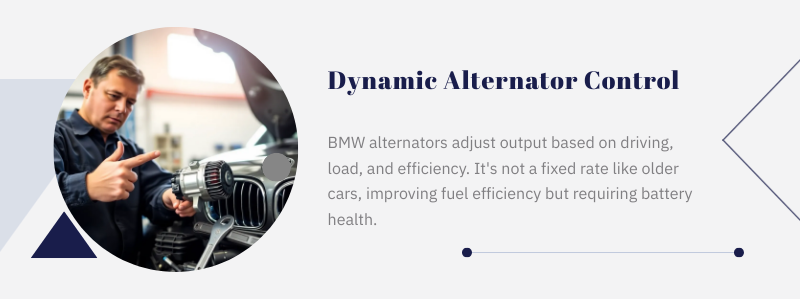
How BMW alternators differ from conventional charging systems
BMW alternators are controlled dynamically by the engine management system rather than charging at a fixed rate. Output varies based on driving conditions, load demand, and efficiency targets. This approach reduces fuel consumption but places greater importance on battery health and sensor accuracy.
When alternator output becomes inconsistent, the vehicle prioritizes essential systems while disabling secondary features. This creates the impression of unrelated failures when the root cause is charging imbalance.
Alternator failure versus battery failure in BMWs
Battery failure typically presents as voltage-related faults during startup or short trips. Alternator issues emerge during sustained driving, high electrical load, or highway speeds. Distinguishing between the two requires live diagnostic data rather than static voltage testing.
Replacing one without verifying the other often leads to repeat failures. Accurate diagnosis prevents unnecessary expense and restores full system integrity.
Parasitic battery drain in modern BMW vehicles
BMW vehicles draw power continuously to maintain network readiness, security systems, and memory functions. This baseline draw is normal, but faults within control modules or accessories increase consumption beyond design limits. Excessive parasitic drain discharges even new batteries rapidly.
Aftermarket electronics installed improperly are a frequent contributor, especially audio equipment or tracking devices. In Dallas, heat-related insulation breakdown can also cause wiring leakage that mimics parasitic draw.
Diagnosing parasitic draw without guesswork
Effective diagnosis isolates circuits methodically while monitoring live draw values. Random fuse pulling or battery replacement does not resolve the underlying cause. Identifying the specific module or wiring fault prevents repeat discharge and preserves system stability.
Proper testing distinguishes between normal sleep cycles and abnormal draw patterns. This distinction is critical in BMW platforms with extended shutdown timers.
Electrical module failures common in BMW platforms
BMW vehicles rely on multiple control modules that communicate continuously. Voltage instability damages these modules over time, leading to intermittent or permanent failure. Commonly affected systems include comfort access, body control modules, and lighting control units.
Once module integrity is compromised, replacing the battery alone does not restore function. Targeted diagnostics identify whether the fault lies in the module itself, wiring integrity, or upstream power delivery.
Climate impact on BMW electrical reliability in North Texas
Sustained heat accelerates aging across batteries, wiring insulation, and connectors. Dallas and Plano experience prolonged high temperatures that exceed design assumptions for cooler climates. BMW systems compensate electronically, but compensation has limits.
Vehicles parked outdoors or driven short distances experience compounded stress. Regular electrical evaluations mitigate this risk by identifying degradation before functional failure occurs.
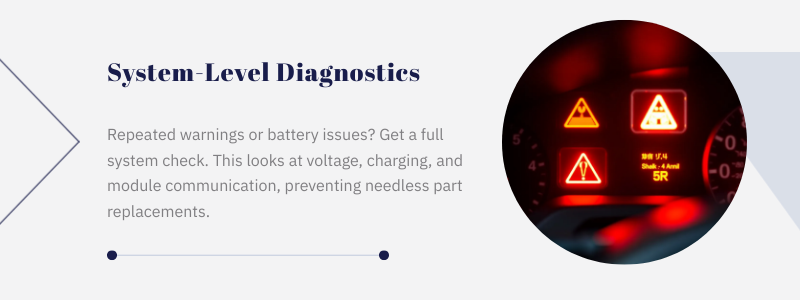
When a BMW requires full electrical system diagnostics
Repeated warning lights, battery replacements within short intervals, or persistent electrical faults indicate system-level issues. Full diagnostics evaluate voltage stability, charging behavior, and module communication collectively rather than in isolation.
This approach prevents unnecessary component replacement and ensures long-term reliability. It is especially relevant for BMW owners experiencing recurring issues despite recent repairs.
Preventive electrical maintenance for BMW owners in Dallas and Plano
Proactive electrical inspections extend battery life and prevent sudden failures. Monitoring charging behavior, verifying battery registration status, and testing parasitic draw reduce long-term costs. These measures are particularly valuable in high-heat environments.
Preventive maintenance also protects sensitive electronics that are costly to replace once damaged. Maintaining voltage integrity preserves overall vehicle performance.
How BMW electrical issues affect drivability and safety systems
Electrical instability directly impacts braking assistance, steering calibration, and driver assistance features. These systems rely on precise voltage thresholds to function correctly. When voltage drops or fluctuates, safety systems may deactivate without mechanical failure.
Resolving electrical faults restores not only convenience features but also core safety functions. This relationship underscores the importance of addressing issues promptly rather than deferring repair.
BMW electrical repair requires platform-specific expertise
Generic diagnostic approaches often misinterpret BMW fault codes or overlook underlying voltage issues. BMW systems require familiarity with network behavior, power management logic, and module dependencies. Accurate repair depends on understanding these interactions.
Specialized diagnostics prevent trial-and-error repairs and reduce downtime. This expertise is critical for maintaining reliability in complex BMW electrical architectures.

BMW Intelligent Battery Sensor failures disrupt charging accuracy
BMW’s Intelligent Battery Sensor monitors voltage, current flow, and battery temperature in real time. This data informs charging strategy, load shedding, and alternator output. When the sensor fails or reports inaccurate values, the vehicle mismanages power even if the battery itself is healthy.
A faulty sensor commonly results in undercharging during city driving or overcharging during highway operation. Both conditions shorten battery life and destabilize electrical systems. In hot Dallas conditions, sensor inaccuracies are amplified because temperature data plays a critical role in charging calculations.
Symptoms specific to Intelligent Battery Sensor faults
Erratic charging warnings, inconsistent start-stop behavior, and repeated battery-related fault codes indicate sensor failure. These symptoms persist even after battery replacement. Replacing batteries without validating sensor output often leads to repeat electrical complaints.
Voltage drops during startup reveal deeper electrical weaknesses
BMW vehicles perform high-load electrical checks during startup, engaging multiple modules simultaneously. Voltage must remain within a narrow range for successful initialization. If voltage drops below threshold momentarily, modules may fail to initialize correctly.
This results in sporadic warning lights that disappear after driving. While often dismissed as software glitches, these events signal declining electrical reserve capacity. Addressing startup voltage drop prevents long-term module communication issues.
Grounding integrity plays a critical role in BMW electrical stability
BMW electrical systems rely on precise grounding paths to maintain signal accuracy and current flow. Corrosion, loose ground straps, or heat-related degradation introduce resistance that mimics battery or alternator failure. These issues are common in regions with extreme temperature swings.
Ground faults cause inconsistent sensor readings and intermittent faults across unrelated systems. Proper diagnosis includes resistance testing and thermal inspection rather than visual checks alone.
BMW start-stop system malfunctions often trace back to power management
Auto start-stop functionality depends on battery state-of-charge, temperature, and reserve capacity. When electrical conditions fall outside acceptable ranges, the system disables itself to protect core functions. This behavior is intentional, not a malfunction.
Drivers in Dallas frequently report start-stop inconsistency after battery replacement or during heat waves. In most cases, the issue lies in battery adaptation data, charging strategy errors, or unregistered components rather than the system itself.
Software-controlled load shedding explains disappearing vehicle features
BMW uses load shedding to preserve critical systems when voltage drops. Non-essential features such as heated seats, climate control intensity, or infotainment responsiveness may be reduced or disabled temporarily. This often confuses drivers who assume component failure.
Load shedding indicates the system is compensating for insufficient electrical reserve. Correcting the underlying power issue restores normal operation without replacing affected features.

Electrical faults can masquerade as drivetrain or transmission issues
Many drivetrain and transmission warnings originate from voltage instability rather than mechanical failure. Control units governing these systems require precise voltage to interpret sensor data accurately. Fluctuations distort readings and trigger fault logic.
This is why BMW electrical diagnostics must precede mechanical conclusions. Stabilizing voltage often resolves performance warnings without mechanical intervention.
CAN bus communication errors stem from electrical inconsistencies
BMW modules communicate via high-speed CAN networks that are sensitive to voltage variation and grounding quality. Electrical instability introduces noise and packet loss, leading to communication faults. These faults appear as random or shifting diagnostic codes.
Resolving CAN-related issues requires restoring electrical integrity before addressing network components. Replacing modules without correcting voltage issues rarely produces lasting results.
Aftermarket accessories introduce hidden electrical risks
Poorly integrated accessories create parasitic draw, grounding conflicts, or signal interference. Common issues arise from audio upgrades, tracking devices, or remote starters installed without BMW-specific integration. These problems often surface months later.
In hot climates, accessory wiring insulation degrades faster, increasing risk. Proper removal or rewiring resolves chronic drain issues and restores baseline electrical behavior.
Electrical system resets are not substitutes for repair
Disconnecting the battery or clearing codes temporarily masks symptoms by forcing module reinitialization. While this may restore normal behavior briefly, it does not correct underlying electrical faults. Recurrent warnings indicate unresolved power instability.
Permanent resolution requires identifying the root cause rather than resetting adaptive logic. This distinction separates lasting repairs from temporary symptom relief.
When repeated battery replacement indicates a system-level problem
Replacing batteries more than once within a short timeframe signals charging or consumption imbalance. The battery is responding correctly to adverse conditions rather than causing them. Continued replacement without diagnosis increases long-term repair cost.
System-level evaluation identifies whether the issue lies in charging control, parasitic draw, sensor accuracy, or module behavior. Correcting the system restores normal battery lifespan.
BMW Electrical & Battery Service – Frequently Asked Questions
How long does a BMW battery typically last in Dallas?
BMW batteries in Dallas often last three to four years due to sustained heat and high electrical demand. Driving patterns and parking conditions influence lifespan significantly.
Does a BMW battery always need to be registered after replacement?
BMW battery registration is required to ensure proper charging behavior and prevent electrical faults. Skipping this step shortens battery life and triggers warning messages.
Why does my BMW show multiple warning lights at once?
Multiple warnings often indicate voltage instability rather than separate failures. A weakened battery or charging issue affects multiple systems simultaneously.
Can short trips drain a BMW battery?
Frequent short trips prevent full recharge cycles, accelerating battery degradation. This is especially common in urban Dallas driving conditions.
Is it safe to drive with a BMW electrical warning light on?
Some warnings indicate reduced system functionality that affects safety features. Continued driving risks further damage and unpredictable behavior.
What causes overnight battery drain in BMW vehicles?
Excessive parasitic draw from faulty modules, wiring issues, or aftermarket electronics commonly causes overnight discharge.
Does extreme heat damage BMW electrical components?
Prolonged heat accelerates wear on batteries, wiring insulation, and connectors. Regular inspections mitigate this risk.