
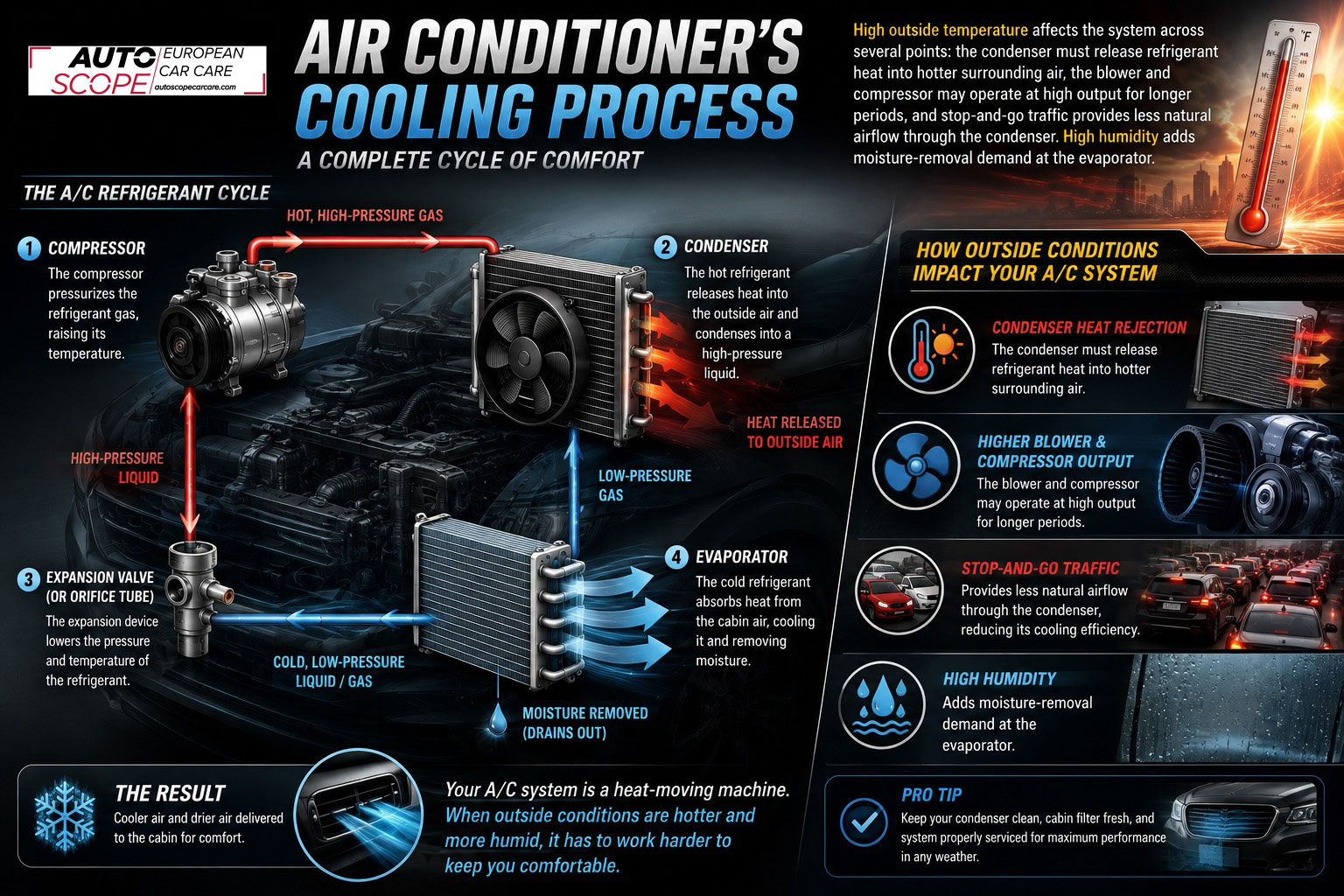
Automotive air conditioning does not create cold air — it moves heat from the cabin to the outside. In a Dallas summer, that process becomes more demanding, and a system that is slightly marginal in April may feel significantly worse in July. The question worth asking is not just whether the AC is cold enough, but whether it is performing the same way it used to.
A car AC system that is not cold enough usually has a problem with refrigerant quantity, heat transfer, airflow, compressor operation or electronic control. The pattern of the problem — such as cooling only while moving, blowing warmer on one side, or starting cold and then fading — helps identify which part of the system should be tested first.
- How Texas Heat Affects AC Performance
- Six Reasons Your AC Isn't Cold Enough
- What the Symptom Pattern Reveals
- Why the C 63 Requires Generation-Specific Diagnosis
- Why Adding Refrigerant Is Not a Complete Diagnosis
- What Vent Temperature Alone Doesn't Tell You
- When to Schedule an Inspection
- Frequently Asked Questions
How Texas Heat Affects AC Performance
Dallas-Fort Worth's normal afternoon highs are 95.6°F in July and 95.8°F in August, with approximately 20 days per year at or above 100°F based on current 30-year climate normals. A closed vehicle parked in direct sunlight creates an even greater initial cooling load, because the seats, dashboard, glass and interior surfaces continue releasing stored heat after the AC is switched on.
High outside temperature affects the system across several points: the condenser must release refrigerant heat into hotter surrounding air, the blower and compressor may operate at high output for longer periods, and stop-and-go traffic provides less natural airflow through the condenser. High humidity adds moisture-removal demand at the evaporator.
A healthy AC system should still produce meaningful cooling in these conditions. It may take longer to reduce the temperature of a heat-soaked cabin, but air that remains warm, becomes noticeably weaker or cools only under limited conditions suggests a problem that should be tested — not blamed on the weather.
These factors compound one another. A system that passed last summer may not handle this summer if a component has weakened in the intervening months.
Six Reasons Your Car AC Isn't Cold Enough
Refrigerant circulates through the AC system, changing pressure and state as it absorbs heat inside the cabin and releases that heat at the condenser. The system requires a specified refrigerant type and charge quantity to operate correctly. A low charge can reduce cooling performance — but refrigerant is not consumed like fuel or engine oil. If the system has lost a meaningful amount, a leak is likely present somewhere.
Adding refrigerant without determining why the level is low provides only temporary relief and can result in an incorrect charge if refrigerant is added without recovering and measuring what remains. Potential leak points include:
- Compressor shaft seals
- Hose connections and line fittings
- Service ports
- Condenser damage
- Evaporator leakage
- Pressure sensors or related fittings
The condenser sits near the front of the vehicle where moving air carries away heat from the high-pressure refrigerant. Cooling may weaken if road debris blocks part of the condenser, fins are bent, an electric cooling fan does not reach the required speed, air guides or underbody panels are missing, or the condenser has been damaged by an impact.
A condenser-airflow problem often becomes most noticeable at idle or in slow traffic — the AC may feel cooler at highway speed because vehicle movement forces more air through the condenser. That pattern is diagnostically useful, but it does not confirm one specific part. Refrigerant pressure, fan commands, actual fan speed and condenser condition should be evaluated together.
The compressor creates the pressure difference that allows the refrigerant to absorb and reject heat. If it cannot produce the required pressure, cabin cooling suffers. Compressor-related problems can include internal mechanical wear, a control-valve problem, incorrect electrical commands, a pressure or temperature sensor supplying inaccurate information, or a control module preventing operation because of another detected condition.
A compressor should not be replaced solely because the vents are warm. Pressure readings and electronic commands can reveal whether the compressor is being asked to operate, whether it responds correctly and whether another system is restricting its operation.
Cold evaporator temperature will not cool the cabin effectively if the blower cannot move enough air through the vents. Weak airflow may result from a restricted cabin air filter, a failing blower motor, a blower-control problem, a blocked evaporator surface or evaporator icing that restricts flow.
The distinction matters diagnostically: warm air with normal airflow points toward refrigerant, compressor, heat-transfer or temperature-control problems. Cold air that barely exits the vents directs the diagnosis toward the blower and air path.
Automatic climate-control systems regulate cabin temperature by controlling airflow, blower speed and the path air takes through the HVAC housing. A door or actuator problem may cause one side of the cabin to blow warmer than the other, temperature that does not respond to control adjustments, clicking or tapping behind the dashboard, or cooling that changes after restarting the vehicle.
A dual-zone system can produce uneven temperatures even when the refrigerant circuit is working correctly. Checking vent temperatures at several outlets helps separate a cabin-air-distribution problem from a system-wide loss of cooling.
Modern Mercedes-Benz climate control depends on sensors, actuators and control modules. A mechanical AC system can contain the correct refrigerant charge and still perform poorly if its electronic controls receive incorrect data or fail to command the proper response.
Mercedes-Benz issued a technical bulletin covering intermittent loss of cooling on certain non-hybrid model-series 205 vehicles manufactured from October 15, 2018. The bulletin identified a possible software fault in the air-conditioning control unit and prescribed an updated software release. Model series 205 includes the W205-generation C-Class and Mercedes-AMG C 63 — but the bulletin's production and equipment limitations matter. Its existence does not mean every W205 C 63 with weak AC needs a software update. It demonstrates why vehicle identification, fault memory and manufacturer-specific information belong in the diagnostic process from the start.
What the Symptom Pattern Reveals
The way the system behaves provides more useful information than simply saying the AC doesn't work. These patterns are not final diagnoses — several faults can produce similar behavior, particularly in extreme heat — but they are useful starting points for testing.
Note the pattern before calling — whether it happens at idle or speed, on one side or both, immediately or after warming up. That information helps a technician test the right system first.
Why the Mercedes-AMG C 63 Requires Generation-Specific Diagnosis
The C 63 name spans substantially different powertrains and electrical architectures. The correct diagnostic approach depends on identifying the exact chassis, model year and equipment before any testing begins. A Mercedes-Benz specialist familiar with each AMG generation will approach the same complaint differently depending on which platform is in the bay.
Age is the primary factor — rubber seals, hoses, connectors, fan assemblies and condensers have experienced years of vibration and heat cycling. The cause is more likely gradual leakage or component wear than a design problem.
Tighter underhood packaging and electronic climate control. The Mercedes-Benz technical bulletin for intermittent AC on certain non-hybrid W205 vehicles built after October 15, 2018 must be evaluated for applicability before assuming software is the cause.
High-voltage plug-in hybrid architecture. Diagnosis and repair require appropriate equipment, technical procedures and high-voltage safety qualifications — not standard AC service.
This generational difference is one reason a generic AC recharge may be inadequate. The correct refrigerant, charge quantity, equipment and diagnostic process must match the individual vehicle. What applies to a W204 can be wrong for a W206 — and vice versa.
Why Adding Refrigerant Is Not a Complete Diagnosis
A refrigerant recharge may restore cooling when the charge is low, but it does not identify the source of the loss. Professional AC service goes further — it determines why the system is not performing and confirms the repair is based on evidence rather than assumption.
A complete AC service may include identifying the specified refrigerant, checking the vehicle for stored climate-control faults, measuring vent temperature under defined test conditions, reading high- and low-side refrigerant pressures, evaluating condenser and fan operation, recovering and measuring the existing refrigerant, testing for leakage and charging the system to the vehicle's specified quantity.
Refrigerant must be recovered with appropriate equipment rather than released during service. Federal requirements call for recovered refrigerant to be recycled or reclaimed before being charged back into a vehicle. "Adding a little more" is not a precise or compliant way to service the system — both undercharging and overcharging can interfere with cooling performance.
What Vent Temperature Alone Doesn't Tell You
A thermometer at the center vent is useful, but the reading must be interpreted in context. AC output is affected by outside temperature, relative humidity, initial cabin temperature, engine speed, vehicle speed, recirculation setting, blower speed, sun exposure and time since the system was activated. A single vent-temperature target applied to every vehicle on every Dallas afternoon can be misleading.
It is also useful to compare temperatures across multiple vents. A significant left-to-right difference may indicate an air-distribution or zone-control problem rather than insufficient refrigerant throughout the system — a distinction that changes both the diagnosis and the repair.
When noting the AC problem, record whether it occurs at idle or highway speed, on one side or both, immediately after startup or after the cabin has cooled, and whether it has changed since the last service. This information helps a technician design the right test rather than starting from scratch.
When AC Performance Requires Prompt Attention
A minor reduction in cooling can be the first visible sign of a slow leak or weakening component. Identifying the cause before the system loses all cooling allows the repair to be based on evidence rather than assumptions made under pressure. Schedule an inspection when any of the following are true.
Autoscope's factory-trained technicians use European factory diagnostic tools for Mercedes-Benz AC diagnosis at both its Plano and White Rock locations. The diagnostic process may need to combine refrigerant measurements with climate-control fault data, fan commands, temperature-sensor readings and vehicle-specific technical information — not a generic recharge procedure.
Mercedes-AMG AC Diagnosis in Dallas and Plano
Factory-trained technicians. European factory diagnostic equipment. A 3-year/36,000-mile labor warranty on every repair. Schedule at either location — no urgency tactics, no guesswork.
Frequently Asked Questions
Why is my car AC cool but not cold?
The system may have a low refrigerant charge, restricted condenser airflow, weak compressor output or a temperature-control problem. Extreme outside temperature can reduce performance, but a clear decline from previous operation warrants testing rather than assuming the heat is to blame.
Why does my C 63 AC get warmer when I stop?
Cooling that weakens at idle often indicates inadequate airflow through the condenser. The cooling fans, fan controls, condenser condition and refrigerant pressures should all be checked before identifying the cause — the pattern points toward an airflow problem but does not confirm which component.
Why is one side of my Mercedes blowing warmer air?
Uneven temperatures can result from a temperature door, actuator, sensor or zone-control problem. Refrigerant conditions can sometimes contribute, so vent temperatures and system pressures should be evaluated together rather than assuming either the refrigerant circuit or the distribution system is the sole cause.
Can I fix weak AC by adding refrigerant?
Only if an accurate test confirms the system is undercharged — and even then, the reason for the refrigerant loss should be investigated. Adding refrigerant without measuring the existing charge can overfill the system or conceal a leak that will create the same problem again.
Could my W205 C 63 have an AC software problem?
Certain non-hybrid model-series 205 vehicles manufactured from October 15, 2018 were covered by a Mercedes-Benz bulletin addressing intermittent cooling caused by a possible climate-control software fault. The vehicle's identification and equipment must be confirmed before assuming the bulletin applies — not every W205 C 63 with warm AC needs a software update.
Is AC service different on the current C 63 hybrid?
Yes. The current C 63 S E PERFORMANCE combines its climate-control and thermal systems with a high-voltage plug-in hybrid architecture producing 671 combined horsepower. Diagnosis and repair require appropriate equipment, technical information and high-voltage safety procedures — not standard AC service practices.
- National Weather Service Fort Worth/Dallas, "DFW — Normals, Means and Extremes," 1991–2020 climate normals. weather.gov
- U.S. Environmental Protection Agency, "Handling Contaminated Automotive Refrigerants," updated 2026. epa.gov
- Mercedes-Benz USA/NHTSA, "Air Conditioning Intermittently Does Not Cool," Topic LI83.30-P-071494, 2020. nhtsa.gov
- Mercedes-Benz USA, "2026 AMG C 63 S E PERFORMANCE Sedan," accessed 2026. mbusa.com
- U.S. Environmental Protection Agency, "Options for Recharging Your Air Conditioner," updated 2026. epa.gov
- U.S. Environmental Protection Agency, "Regulatory Requirements for MVAC System Servicing," updated 2026. epa.gov
- Autoscope European Car Care, "Mercedes-Benz Service in Dallas," accessed 2026. autoscopecarcare.com