
When your Bentley begins pulling to one side, vibrating at highway speeds, or showing uneven tire wear, the issue is more than a comfort concern, it’s a performance and safety issue. Bentley vehicles rely on extraordinary engineering: air suspension, advanced chassis control, and highly tuned steering geometry. When alignment is even slightly off, the entire driving experience changes.
In the Dallas and Plano area, where heat, road conditions, and traffic stress suspension components, Bentley owners need more than a basic “tire shop alignment.” You need specialist-level calibration, Bentley-approved equipment, and technicians trained to work on precision luxury chassis systems.
What Does a Bentley Alignment Actually Involve?
A wheel alignment ensures that all four wheels are set to Bentley-specified angles: camber, caster, toe, thrust angle, and ride height calibration.
Bentley alignment is more complex than standard vehicles because of:
- Air suspension systems that actively manage ride height
- High-performance tires with narrow tolerances
- Heavy chassis weight that magnifies misalignment
- Advanced steering/suspension modules requiring recalibration
- Larger wheels and low-profile tires sensitive to road impacts
A standard tire shop may adjust toe and send you home; a proper Bentley alignment involves software calibration, multi-point mechanical inspection, and precision adjustments.
When alignment is incorrect, Bentley vehicles may:
- Drift or pull to one side
- Vibrate at 55–75 mph
- Wear tires prematurely or unevenly
- Trigger chassis control warnings
- Lose steering sharpness and stability
Because Bentleys are designed to deliver effortless, stable, ultra-smooth driving, alignment issues are often more noticeable, and more damaging if ignored.
Why Dallas & Plano Conditions Make Alignment Issues More Common
Bentley owners in North Texas experience alignment and tire wear sooner than owners in cooler climates. Here’s why:
Extreme Heat
- Dallas summers exceed 100°F often.
- Heat accelerates rubber wear and causes bushings, ball joints, and tires to soften or deform.
- Tire pressure fluctuates heavily between morning and afternoon temperatures (up to 5–8 PSI difference).
City & Interstate Driving
- Sudden braking, potholes, construction zones, and uneven surfaces throw alignment off.
- Bentleys with low-profile tires and large rims are especially vulnerable to impact distortion.
Heavy Chassis + Luxury Suspension
- Bentleys weigh 5,000+ lbs.
- Under high heat and road stress, suspension components loosen faster than lighter vehicles.
The result:
Bentley alignments and tires require more frequent checks in Dallas/Plano—typically every 6–8 months vs. the standard 12 months in moderate climates.
Common Causes of Bentley Alignment & Tire Problems
Below is a breakdown of frequently diagnosed issues, their meanings, and why they occur.
| Cause | What It Means | Why It Happens |
| Pothole or curb impact | Wheel angle changes instantly | Dallas road construction, tight parking situations |
| Air suspension height deviation | Incorrect ride height ruins alignment | Leaking air bags, sensors, or compressor strain |
| Worn control arm bushings | Wheels shift under load | Heavy chassis, Texas heat accelerating wear |
| Uneven tire pressure | Car pulls or vibrates | Large Bentley wheels react strongly to PSI imbalance |
| Bent wheel or rim | Vibration, wobble, irregular wear | Low-profile tires absorb less impact |
| Ball joint / tie rod wear | Steering play, instability | Normal wear accelerated by heavy luxury weight |
| Incorrect tire size or brand | Chassis system mis-calibration | Non-Bentley-approved tires change geometry |
Bentley components operate within extremely tight tolerances. Even a few millimeters off can cause drivetrain stress, suspension wear, or chassis warnings.
Alignment vs. Tire Balancing
Alignment
Corrects wheel angles relative to the vehicle’s geometry.
Balancing
Corrects uneven weight distribution in the wheel/tire assembly.
Bentleys typically require road-force balancing, which simulates weight under load and is more accurate for luxury wheels.
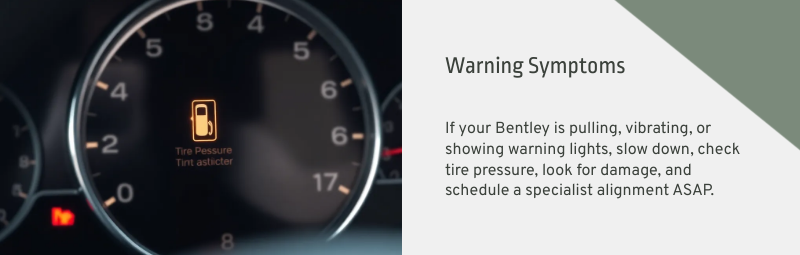
What To Do When Your Bentley Shows Alignment or Tire Warning Symptoms
If your Bentley displays a steering, tire pressure, or suspension warning, or you feel pulling, vibration, or a rough ride, here’s what to do:
1. Reduce Speed
Bentley wheels can be damaged rapidly if misaligned or unbalanced.
2. Check Tire Pressure
Use Bentley-approved PSI. A few PSI difference can cause severe pulling.
3. Look for Visible Signs
- Bubbles or cuts on sidewalls
- Uneven tire wear
- Bent wheel edges
4. Avoid High-Speed Driving
Vibration can worsen and damage suspension components.
5. Schedule a Bentley-Specialist Alignment
A generic tire shop cannot perform ride height calibration or Bentley-specific geometry corrections.
“Is It Safe to Keep Driving?”
Short answer: Only for short distances.
Driving with misalignment or damaged tires can cause:
- Premature tire failure
- Steering instability
- Air suspension strain
- Premature bushing and ball-joint wear
- Safety hazards at high speed
Bentley wheels and suspension components are expensive, early diagnosis saves thousands.
Mini Checklist: Signs Your Bentley Needs Immediate Attention
- Steering wheel not centered
- Car drifts or pulls
- Vibrations above 50 mph
- Irregular tire wear
- “Tire Pressure,” “Chassis,” or “Suspension” warnings
- Thumping or wobbling sound
- Vehicle sits unevenly (air-suspension height issue)
Can You “Reset” an Alignment or Warning Yourself?
You can reset a TPMS warning, but not alignment.
If a warning disappears after restarting, the underlying issue still exists. Bentleys store chassis and steering angle data; the system will reflag the issue once conditions reappear.
Common Bentley Tire & Alignment Issues — and What They Feel Like
Air Suspension Height Sensor Issues
- Car leans to one side
- Steering feels light or unstable
- “Chassis Control” warning may appear
Bent Wheel
- Sharp vibration between 60–70 mph
- Slight wobble at low speed
Uneven or Incorrect Tire Pressure
- Immediate pulling to one side
- Increased road noise
Worn Bushings or Control Arms
- Loose or wandering steering
- Clunks over bumps
Improper or Delayed Alignment
- Irregular tire wear
- Steering wheel off-center
- Reduced high-speed stability
Non-Bentley Tires/Wrong Sizes
- Poor ride quality
- Inaccurate chassis readings
- Instability at high speed
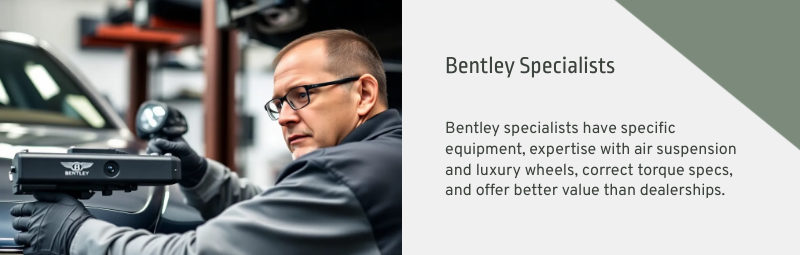
Why Choose a Bentley Specialist Instead of a General Repair Shop
Bentleys require precise alignment and tire work that conventional shops cannot perform. A Bentley specialist provides:
1. Bentley-Specific Alignment Equipment
Standard machines cannot read Bentley ride-height data or advanced steering geometry.
2. Expertise With Air Suspension Systems
Bentley air struts, height sensors, and compressor systems must be calibrated after alignment.
3. Experience With Large Luxury Wheels
22” and 21” rims require road-force balancing and torque accuracy.
4. Correct Torque Specs & OEM Procedures
Over- or under-torqued wheels cause vibration and premature wear.
5. Better Value Than Dealerships
Dealers provide factory service but often at higher cost and longer wait times.
Specialists match quality with better turnaround times.
What It Means for Drivers & Business Professionals
For Bentley Drivers
An alignment issue may seem minor, but the consequences aren’t:
- Tires wear prematurely ($500–$900 each)
- Suspension components strain under misalignment
- Performance and comfort decline noticeably
Fixing alignment early saves thousands over the vehicle’s life cycle.
For Business Owners / Professionals
If your Bentley is part of your professional image or daily mobility:
- Downtime means lost productivity
- Poor ride quality affects client impressions
- Vibration or pulling compromises safety on business travel
Our Dallas/Plano facility focuses on fast, accurate, luxury-grade service with transparent estimates.
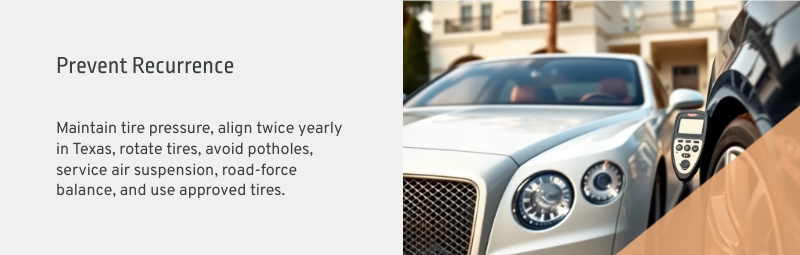
Maintenance Moves That Prevent Recurrence
1. Maintain Proper Tire Pressure
Check monthly and seasonally.
2. Align Twice Per Year in Texas
Dallas road and climate conditions require more frequent checks.
3. Rotate Tires on Schedule
Bentleys with staggered tire setups need special rotation patterns.
4. Avoid Potholes & Construction Zones When Possible
Especially with 20–22” wheels.
5. Keep Air Suspension in Good Health
Have height sensors and struts inspected annually.
6. Balance Tires Using Road-Force Method
Mandatory for luxury wheels to avoid vibration.
7. Use Bentley-Approved Tire Brands
Ensures correct speed, load rating, and geometry.
Cost of Ignoring Bentley Alignment & Tire Issues (What It Really Adds Up To)
Many Bentley owners underestimate how quickly a small alignment issue turns into a major repair bill. Because Bentleys run on ultra-precise suspension geometry and high-performance tires, delaying service almost always multiplies the cost. Here’s what “waiting too long” typically turns into:
- Accelerated Tire Wear – $1,000 to $3,600
When alignment is off even a few millimeters, a Bentley can chew through a set of tires in half the expected lifespan. Shoulder wear, cupping, and feathering appear quickly—especially in Texas heat. - Air Suspension Stress – $1,500 to $6,000+
Misalignment forces the air struts and height sensors to compensate constantly. Over time, this causes premature bag leakage, sensor failure, or compressor strain. - Steering & Chassis Component Damage – $800 to $4,000
Bentleys use heavy control arms, ball joints, and bushings engineered for smooth, balanced loads. Misalignment puts uneven force on these parts, causing early wear and instability. - Wheel & Rim Damage – $300 to $1,500+ each
If vibration is ignored, a slightly bent wheel can worsen, cracking the rim or damaging the tire bead—especially on 21–22” wheels. - Safety Risks at Highway Speeds
Pulling, vibration, or sudden chassis warnings impair stability—critical when driving on I-75, Dallas North Tollway, or George Bush Turnpike at interstate speeds.
Bottom Line:
Spending a little on proper Bentley alignment now saves thousands later. For a high-performance vehicle engineered for precision, alignment isn’t optional maintenance, it’s essential protection for your investment.
FAQs – Bentley Wheel Alignment
Q: How often should my Bentley get an alignment?
Every 6–8 months in Dallas, or anytime you hit a pothole or notice tire wear.
Q: Are Bentley alignments more expensive than normal cars?
Yes, due to air suspension calibration, advanced steering geometry, and specialty equipment.
Q: Do I need Bentley-specific tires?
Using Bentley-approved tires is strongly recommended for proper handling and safety.
Q: Why is my Bentley vibrating at highway speeds?
Common causes include bent wheels, unbalanced tires, or alignment deviations.
Q: Can a regular tire shop align a Bentley?
Not correctly. A Bentley requires specialized equipment and ride-height calibration.
Q: Can alignment issues trigger warning lights?
Yes—chassis, tire pressure, or steering angle warnings may appear.
Q: How long does a Bentley alignment take?
Typically 1.5–2 hours with full calibration.
Q: Why do my Bentley tires wear out so fast?
High weight, large wheels, Texas heat, and misalignment accelerate wear.
Q: What tires do you recommend?
Pirelli P Zero, Michelin Pilot Sport, and Continental ContiSport models are common OEM choices.
Q: Should I replace all four tires at once?
For AWD models, replacing all four maintains correct rolling diameter and prevents drivetrain stress.