
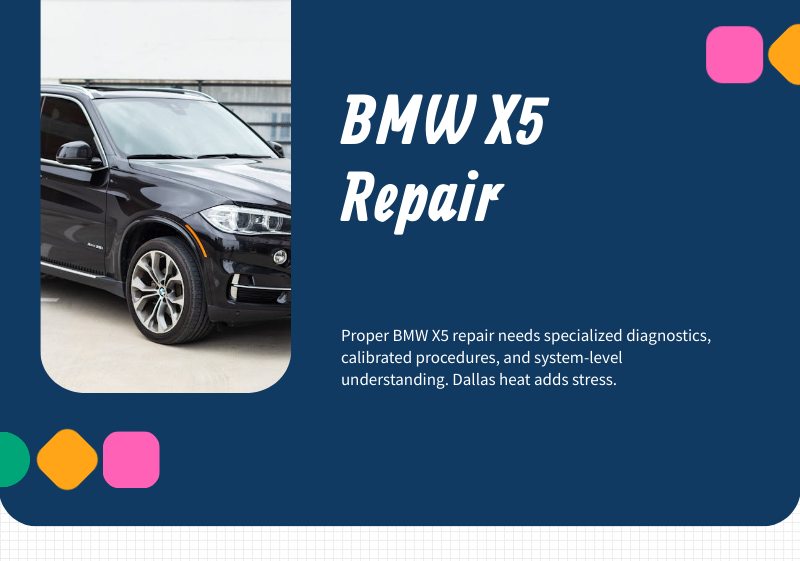
What Defines Proper BMW X5 Repair in Plano, Dallas, and White Rock?
BMW X5 repair requires BMW-specific diagnostics, calibrated repair procedures, and system-level understanding of how mechanical and electronic components interact.
The BMW X5 platform integrates engine management, drivetrain control, suspension systems, and onboard electronics into a tightly coordinated architecture. A repair that addresses only a visible symptom—without validating underlying system behavior—frequently results in recurring faults.
A properly executed BMW X5 repair process includes:
- Factory-grade diagnostic scanning and fault interpretation
- Verification of related systems, not just isolated components
- Replacement with OEM or equivalent-spec components
- Post-repair recalibration and adaptation resets
- Validation through drive-cycle testing under real conditions
In Plano, Dallas, and White Rock, where heat exposure and traffic patterns increase system stress, this level of precision becomes necessary rather than optional.
What Mechanical and System Failures Are Most Common in BMW X5 Models?
BMW X5 failures cluster around predictable wear points tied to heat, pressure, and electronic control dependencies.
These issues do not occur randomly. They follow patterns that align with mileage, climate, and usage conditions.
Core Failure Categories
- Oil Sealing Failures
Valve cover gaskets and oil filter housing gaskets degrade over time, leading to leaks that can affect surrounding components. - Cooling System Weak Points
Electric water pumps, thermostats, and plastic cooling components are subject to heat fatigue and sudden failure. - Ignition System Degradation
Coil packs and spark plugs wear unevenly, resulting in misfires and reduced engine efficiency. - Transmission Behavior Changes
Fluid breakdown and adaptation drift lead to rough shifting or hesitation under load. - Electronic System Instability
Battery-related faults, sensor failures, and control module inconsistencies can trigger cascading warning messages.
BMW X5-Specific Concerns
- Air Suspension Fatigue
Rear air springs and compressors degrade, causing uneven ride height and handling instability. - xDrive Transfer Case Wear
Internal clutch wear leads to binding, vibration, or drivetrain fault alerts. - Carbon Accumulation in Turbo Engines
Direct injection systems allow intake valve deposits to build, affecting airflow and performance.
Each of these issues reflects a broader system dependency. Addressing only the visible failure often leads to incomplete repair outcomes.

How North Texas Driving Conditions Affect BMW X5 Reliability
High temperatures, stop-and-go traffic, and short driving cycles accelerate mechanical and electronic wear in BMW X5 vehicles.
Environmental factors in Plano, Dallas, and White Rock introduce additional stress across multiple systems:
- Sustained Heat Exposure
Cooling systems operate near upper thresholds, reducing component lifespan. - Urban Traffic Patterns
Frequent braking and acceleration increase wear on transmission and brake systems. - Short Trip Driving
Incomplete engine warm-up contributes to carbon buildup and oil contamination. - Road Surface Variability
Suspension systems absorb repeated impact stress, especially in heavier SUVs like the X5.
These conditions shift maintenance from reactive to preventative. Waiting for visible failure often results in more extensive repairs.
Why BMW X5 Repairs Require a Specialist Mechanic
BMW X5 systems require platform-specific diagnostics and calibration steps that general repair shops typically do not perform.
BMW engineering integrates software-driven control into nearly every mechanical function. Repairs often require system communication resets, coding procedures, or adaptation learning cycles.
Key Differences in Capability
| Area | BMW Specialist | General Mechanic |
| Diagnostics | Manufacturer-level systems | Basic scan tools |
| System calibration | Performed consistently | Often omitted |
| Software updates | Integrated into repair workflow | Rarely available |
| Component matching | VIN-specific validation | Generic fitment |
| Failure pattern recognition | Model-specific expertise | Generalized knowledge |
Examples of required post-repair processes include:
- Battery registration to prevent charging system faults
- Brake system electronic resets after pad replacement
- Transmission adaptation relearning after service
Without these steps, the vehicle may continue to display faults despite completed repairs.
What Determines the Cost of BMW X5 Repair in Dallas and Plano?
BMW X5 repair costs are driven by system complexity, diagnostic time, and component integration rather than part replacement alone.
Unlike simpler vehicles, the cost structure includes both physical repair and system validation.
Primary Cost Drivers
- Diagnostic depth required to isolate root cause
- Labor intensity due to component accessibility
- Electronic calibration and software integration steps
- OEM versus aftermarket component selection
- Extent of related system impact
Typical Cost Ranges by Category
| Repair Type | Estimated Range |
| Oil leak repair | $400 – $1,200 |
| Cooling system repair | $800 – $2,000 |
| Ignition system service | $300 – $900 |
| Air suspension repair | $1,200 – $4,000 |
| Transfer case repair | $1,500 – $3,500 |
Costs vary depending on model year, engine type, and whether secondary damage has occurred.
When Preventative Maintenance Outperforms Reactive Repair
Preventative maintenance reduces total cost and failure frequency by addressing known weak points before system breakdown occurs.
BMW X5 ownership benefits from a predictive maintenance approach rather than relying on warning indicators alone.
High-Value Preventative Intervals
- Cooling system component replacement before failure thresholds
- Ignition system refresh at consistent mileage intervals
- Transmission fluid service despite “lifetime” labeling
- Suspension inspection and early component replacement
- Carbon cleaning for turbocharged engines
Preventative strategies are particularly valuable in Dallas-area conditions where heat accelerates degradation cycles.

How to Evaluate a BMW X5 Mechanic in Plano, Dallas, or White Rock
A qualified BMW X5 mechanic demonstrates measurable capabilities in diagnostics, system knowledge, and repair validation.
Evaluation Criteria
- Access to BMW-specific diagnostic platforms
- Proven experience with X5-specific repairs
- Clear explanation of root cause, not just symptoms
- Ability to perform system calibrations and software procedures
- Use of OEM or equivalent-grade parts
- Structured diagnostic process before repair authorization
Indicators of Incomplete Capability
- Immediate part replacement without diagnostic validation
- Lack of explanation for recurring issues
- Inability to perform post-repair calibration
- Generic service recommendations without model-specific context
Choosing the correct mechanic directly impacts long-term reliability and total ownership cost.
How BMW X5 Repair Compares to Other Luxury SUVs
BMW X5 repair complexity is higher than many competing SUVs due to system integration and performance-oriented engineering.
Comparative Characteristics
| Vehicle Type | Repair Complexity | Electronic Integration | Maintenance Sensitivity |
| BMW X5 | High | Extensive | High |
| Lexus RX | Moderate | Moderate | Lower |
| Audi Q7 | High | Extensive | High |
| Mercedes GLE | High | Extensive | High |
BMW X5 vehicles require stricter adherence to maintenance intervals and repair procedures to maintain performance and reliability.
What Decision Framework Determines Repair vs Replacement
Repair decisions should be based on system condition, cumulative repair cost, and remaining vehicle value.
Decision Criteria
- Total cost of upcoming repairs relative to vehicle value
- Frequency of recent failures
- Condition of major systems (engine, transmission, electronics)
- Availability of reliable repair history
- Intended ownership duration
Practical Evaluation Model
| Condition | Recommended Action |
| Isolated repair, strong overall condition | Repair |
| Multiple system failures, rising frequency | Evaluate replacement |
| High repair cost nearing vehicle value | Consider replacement |
| Well-maintained with predictable issues | Continue maintenance |
This framework ensures decisions are based on long-term value rather than short-term cost.

Where BMW X5 Owners in Dallas and Plano Lose the Most Value
The greatest financial loss occurs when minor issues escalate into system-wide failures due to delayed intervention.
Common escalation scenarios include:
- Small oil leaks leading to major engine component damage
- Cooling system neglect resulting in overheating
- Ignition issues causing catalytic converter failure
- Suspension wear affecting drivetrain components
Each scenario reflects a failure to address early indicators, which increases total repair cost significantly.
BMW X5 Repair – Frequently Asked Questions
How often should a BMW X5 be serviced in Dallas?
Service intervals should be shortened due to heat and driving conditions, typically every 5,000–7,500 miles for key maintenance items.
Is BMW X5 maintenance more expensive than other SUVs?
Maintenance costs are higher due to system complexity and required diagnostic procedures.
Can a general mechanic repair a BMW X5 effectively?
Basic repairs may be possible, but system-level diagnostics and calibration typically require a BMW specialist.
What is the most common BMW X5 repair?
Cooling system failures and oil leaks are among the most frequent issues across multiple model years.
How long does a BMW X5 last with proper maintenance?
Well-maintained models commonly exceed 150,000 miles with consistent preventative care.
Are BMW X5 electrical issues serious?
Electrical faults can affect multiple systems simultaneously and require proper diagnostic tools to resolve.
Does climate affect BMW X5 reliability?
High temperatures accelerate wear on cooling systems, electronics, and fluid-based components.
What Future BMW X5 Repair Will Look Like in Dallas Markets
BMW X5 repair is moving toward increased software dependency, predictive diagnostics, and integrated system servicing rather than isolated mechanical repair.
As newer models incorporate more advanced driver assistance systems, electrification components, and connected diagnostics, repair workflows will increasingly rely on software validation and system recalibration. In markets like Plano, Dallas, and White Rock, where environmental stress remains high, the gap between general repair capability and BMW-specific expertise will continue to widen.