
Audi Q Series Repair in Dallas and Plano Requires Platform-Specific Expertise
Audi Q series repair in Dallas and Plano requires technicians who understand the shared architecture, electronics, and drivetrain systems across Q3, Q5, Q7, and Q8 platforms. Audi’s Q lineup blends turbocharged engines, quattro all-wheel drive, adaptive suspension, and advanced driver-assistance systems that demand precise diagnostic capability.
General European repair experience is not enough. Effective Audi Q series service depends on familiarity with common failure points, software-driven systems, and Texas-specific operating conditions such as heat exposure, traffic density, and highway wear.
What Audi Q Series Models Include and How They Differ Mechanically
Audi Q series vehicles include the Q3, Q4 e-tron, Q5, Q7, and Q8, each built on different chassis platforms with distinct engine and suspension configurations.
Understanding model differences prevents misdiagnosis and improper parts replacement.
Core Gasoline and Hybrid Models
The following overview clarifies mechanical distinctions relevant to service:
| Model | Platform Class | Typical Engine Configuration | Notable Mechanical Traits |
| Audi Q3 | Compact SUV | 2.0L turbocharged inline-4 | Transverse engine layout, compact cooling system |
| Audi Q5 | Compact SUV | 2.0L turbocharged inline-4 or mild hybrid | Longitudinal layout, advanced suspension options |
| Audi Q7 | Midsize SUV | 2.0L turbo or 3.0L V6 | Larger braking system, air suspension availability |
| Audi Q8 | Performance SUV | 3.0L V6 or performance variants | Sport-tuned suspension, adaptive damping systems |
Electric Variant Considerations
Electric Q models introduce battery management and high-voltage system service complexity that requires specialized safety procedures and diagnostic tools.
Incorrect handling of hybrid or electric components can lead to system faults or safety risks. Proper training and equipment are mandatory.
Common Mechanical Issues Affecting Audi Q Series Vehicles
Audi Q series vehicles exhibit predictable wear patterns influenced by drivetrain complexity, turbocharging, and electronic integration.
The most frequent repair categories include:
- Oil consumption and PCV system failures
- Water pump and thermostat housing leaks
- Turbocharger boost regulation faults
- Control arm and suspension bushing wear
- Electronic module communication errors
- Timing chain tensioner wear in higher-mileage units
Dallas heat accelerates plastic component degradation and coolant system stress. Plano traffic conditions increase brake and suspension wear due to frequent stop-and-go driving.
Early detection prevents cascading failures.
Why Quattro System Maintenance Matters in North Texas Driving Conditions
Quattro all-wheel drive systems rely on coordinated mechanical and electronic components to distribute torque accurately. Deferred maintenance compromises drivetrain balance and accelerates differential wear.
Routine service should include:
- Differential fluid inspection and replacement
- Transfer case fluid service
- Driveline vibration evaluation
- Wheel speed sensor diagnostics
Highway commuting between Dallas and Plano places sustained load on drivetrain systems. Proper fluid intervals protect long-term reliability.
What Determines the Quality of an Audi Q Series Mechanic
Audi Q series repair quality depends on diagnostic accuracy, software capability, and platform-specific experience.
Key evaluation criteria include:
- Access to Audi-compatible diagnostic software
- Familiarity with common TFSI engine issues
- Experience servicing adaptive suspension systems
- Ability to interpret manufacturer fault codes correctly
- Understanding of Texas climate-related wear patterns
Technicians who rely solely on generic scan tools often miss manufacturer-specific data. Accurate repair begins with precise diagnosis.
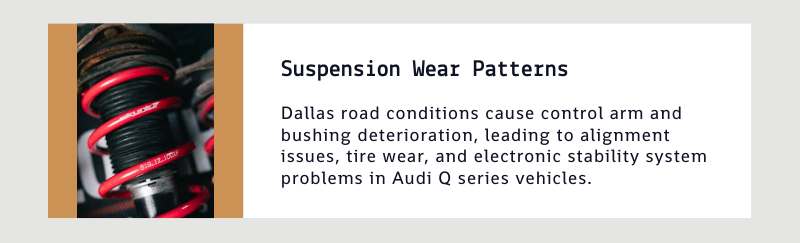
Suspension and Steering Wear Patterns in Dallas and Plano Roads
Audi Q series suspension systems are engineered for performance and comfort but contain multiple wear-prone components. Dallas road expansion joints and uneven pavement accelerate control arm and bushing deterioration.
Typical suspension concerns include:
- Upper and lower control arm bushing failure
- Strut mount noise
- Air suspension leaks in Q7 and Q8 models
- Steering rack electronic faults
Unresolved suspension wear affects alignment, tire life, and electronic stability systems.
Brake System Service Requirements for Audi Q SUVs
Audi Q series vehicles use performance-oriented braking systems with larger rotors and electronic parking brake integration.
Brake service differs from standard SUVs due to:
- Electronic rear brake retraction requirements
- High-temperature rotor composition
- Brake pad sensor integration
- Adaptive cruise control calibration considerations
Improper brake service can trigger dashboard warnings and compromise braking performance.
Engine Cooling and Turbocharger Protection in Texas Heat
Texas heat stresses Audi Q series cooling systems and turbocharged engines. Cooling system failures are among the most common repair categories in Dallas and Plano.
Preventative service includes:
- Coolant pressure testing
- Water pump inspection
- Thermostat housing evaluation
- Radiator fan performance verification
- Turbo coolant line inspection
Heat-related degradation often presents gradually before major failure occurs.
Electrical and Software Complexity in Modern Audi Q Series Models
Audi Q series vehicles rely heavily on networked control modules and software-driven systems. Electrical diagnostics require specialized equipment and manufacturer-level interpretation.
Common electronic issues include:
- MMI system glitches
- Parking sensor faults
- Adaptive headlight module failures
- Driver assistance calibration errors
Software updates often resolve recurring warning lights. Inaccurate module replacement increases cost without addressing root causes.
Service Intervals That Protect Long-Term Reliability
Audi Q series longevity depends on disciplined adherence to service intervals adapted for North Texas conditions.
Recommended maintenance includes:
- Oil service every 5,000–7,500 miles
- Brake fluid replacement every two years
- Differential and transfer case fluid service at manufacturer intervals
- Spark plug replacement for turbocharged engines as specified
- Suspension inspection annually
Aggressive heat and driving patterns may justify more conservative service intervals.
Independent Specialist vs. Dealership for Audi Q Series Repair
Independent Audi specialists often provide more focused platform expertise than general dealership service departments.
Primary differentiators include:
| Factor | Independent Audi Specialist | Dealership Service |
| Technician Focus | Dedicated Audi experience | Multi-brand exposure |
| Scheduling Flexibility | Often faster turnaround | Volume-driven scheduling |
| Cost Structure | Typically more controlled | Higher overhead |
| Relationship Continuity | Direct communication with technician | Advisor-mediated communication |
Proper selection depends on technical capability, not branding alone.
Why Autoscope Is the Preferred Audi Q Series Repair Facility in Dallas and Plano
Autoscope delivers specialized Audi Q series repair with technician-level expertise tailored to Dallas and Plano drivers. The facility focuses on European vehicles and maintains the diagnostic tools required for accurate fault analysis.
Autoscope’s service model emphasizes:
- Platform-specific Audi expertise
- Advanced diagnostic equipment
- Clear repair planning
- Preventative maintenance strategies
- Long-term vehicle performance protection
Audi Q series owners seeking reliable, technically accurate service benefit from a repair facility structured around European engineering rather than general automotive volume.
Preventative Strategies That Reduce Audi Q Series Repair Costs
Preventative maintenance reduces major repair exposure and extends component lifespan.
Effective strategies include:
- Early coolant system inspection
- Proactive suspension evaluation
- Timely turbo system service
- Battery and charging system monitoring
- Software update verification
Waiting for visible failure increases repair complexity and cost.
Signs That Indicate Immediate Audi Q Series Inspection Is Required
Certain symptoms indicate elevated risk and warrant immediate diagnostic attention:
- Persistent check engine light
- Coolant odor or visible leaks
- Drivetrain vibration at highway speeds
- Suspension clunking over minor bumps
- Sudden loss of turbo boost
Prompt inspection prevents compounding mechanical damage.
Audi Q Series Repair in Dallas and Plano Supports Long-Term Vehicle Value
Proper Audi Q series maintenance preserves resale value and ensures consistent performance. Documentation of professional service enhances buyer confidence in the North Texas market.
Vehicles maintained under structured service plans experience fewer catastrophic failures and lower total cost of ownership.
Audi Q5 Mechanic in Plano Must Understand Longitudinal Engine Layout
Audi Q5 service in Plano requires familiarity with longitudinal engine placement and tightly packaged cooling and accessory systems. The layout differs from transverse-engine compact SUVs and influences labor time and diagnostic access.
Common Q5-specific concerns include:
- PCV system pressure irregularities
- Water pump seepage under intake manifold area
- Engine mount deterioration affecting vibration levels
- Mild hybrid battery system communication faults
Accurate identification prevents unnecessary component replacement.
Audi Q7 and Q8 Suspension Systems Demand Advanced Calibration
Audi Q7 and Q8 models frequently use adaptive air suspension or electronically controlled dampers. Repairing these systems requires recalibration after component replacement.
Typical service scenarios include:
- Air strut leakage
- Compressor overwork due to minor system leaks
- Ride height sensor faults
- Adaptive damping warning lights
Calibration ensures ride quality and system longevity.
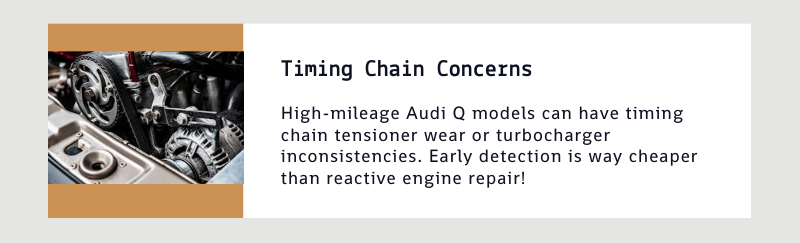
Timing Chain and Turbocharger Concerns in High-Mileage Audi Q Models
Higher-mileage Audi Q series vehicles may experience timing chain tensioner wear or turbocharger boost inconsistencies. Early detection prevents catastrophic engine damage.
Indicators include:
- Cold start rattling noise
- Boost pressure fault codes
- Reduced acceleration under load
- Oil consumption increase
Turbocharged engines depend on clean oil and disciplined intervals.
Why Audi Q Series Check Engine Lights Require Precision Diagnostics
Audi Q series check engine lights often relate to emissions, boost control, or electronic module communication. Generic code scanning rarely reveals full diagnostic context.
Effective diagnosis includes:
- Manufacturer-level fault code retrieval
- Freeze-frame data evaluation
- Sensor plausibility analysis
- Electrical signal verification
Dallas and Plano drivers searching “Audi check engine light reset” often underestimate the complexity of modern Audi control modules. Resetting without diagnosis leads to repeat failures.
Root-cause resolution protects emissions compliance and engine health.
Brake and Rotor Wear in Heavy Audi Q SUVs
Audi Q series SUVs carry significant curb weight and performance-oriented brake systems. Heat cycling and traffic density in Dallas increase pad and rotor wear.
Brake service planning should consider:
- Rotor thickness measurements
- Pad sensor function
- Electronic parking brake retraction
- Brake fluid contamination levels
Brake system integrity also affects driver-assistance systems that rely on predictable deceleration behavior.
Audi Q Series Maintenance Schedule Adaptation for Texas Climate
Texas climate conditions justify adapting standard maintenance schedules. Extended heat exposure accelerates fluid breakdown and plastic component fatigue.
Recommended climate-conscious service planning includes:
- More frequent oil intervals
- Annual coolant system inspection
- Battery testing before peak summer
- Cabin air filter replacement due to dust exposure
Owners searching “Audi maintenance schedule Dallas” are often seeking climate-adjusted guidance rather than generic manufacturer intervals.
Proactive adjustments reduce unplanned downtime.
Transmission and Drivetrain Service in Audi Q Series Vehicles
Audi Q series transmissions rely on precision fluid characteristics and electronic adaptation. Delayed fluid service contributes to shifting irregularities and internal wear.
Drivetrain maintenance typically includes:
- Transmission fluid and filter service
- Mechatronic system inspection
- Differential fluid replacement
- Transfer case fluid monitoring
Quattro-equipped vehicles depend on synchronized drivetrain components.
Audi Electrical System Diagnosis in Modern Q Series Models
Modern Audi Q series vehicles integrate dozens of modules communicating through networked systems. Electrical issues can originate from voltage irregularities rather than component failure.
Key diagnostic considerations include:
- Battery condition testing under load
- Charging system voltage verification
- CAN network communication analysis
- Software update validation
Electrical stability supports overall system reliability.
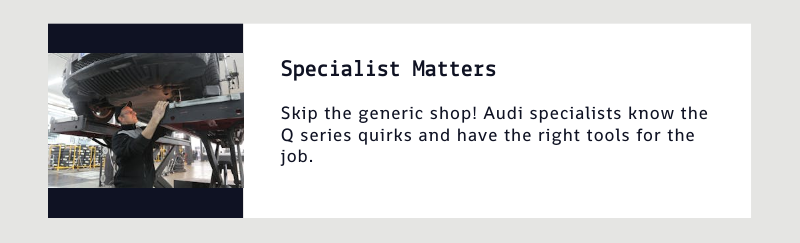
What Audi Q Series Owners Should Expect From a Dallas Specialist
Audi Q series owners should expect structured inspection processes, digital diagnostics, and clear repair prioritization from a Dallas specialist.
Professional service standards include:
- Detailed fault explanation
- Preventative planning guidance
- Accurate repair timelines
- Transparent cost breakdown
- Road testing validation
European-focused facilities are typically better equipped for long-term ownership support.
Audi Q Series Mechanic’s Frequently Asked Questions
How often should an Audi Q5 be serviced in Texas?
Audi Q5 models should receive oil service every 5,000–7,500 miles in Texas due to heat stress and urban driving conditions. Annual inspections of cooling and suspension systems are advisable.
Is Audi Q7 air suspension expensive to repair?
Audi Q7 air suspension repairs can be costly if leaks are ignored. Early detection reduces replacement scope and protects compressor systems.
Can independent shops service Audi Q series vehicles?
Independent shops with Audi-specific diagnostic equipment and European specialization can service Audi Q models effectively. Platform familiarity is essential.
Why does my Audi Q3 have a coolant leak?
Coolant leaks in Audi Q3 models often originate from water pumps or thermostat housings. Plastic components degrade faster in high heat climates.
Does Audi Q series maintenance cost more than other SUVs?
Audi Q series maintenance costs reflect performance engineering and advanced electronics. Preventative service reduces long-term expense.
How long do Audi Q series engines last?
Audi Q series engines can exceed 150,000 miles with consistent maintenance. Turbocharged engines require disciplined oil service intervals.