
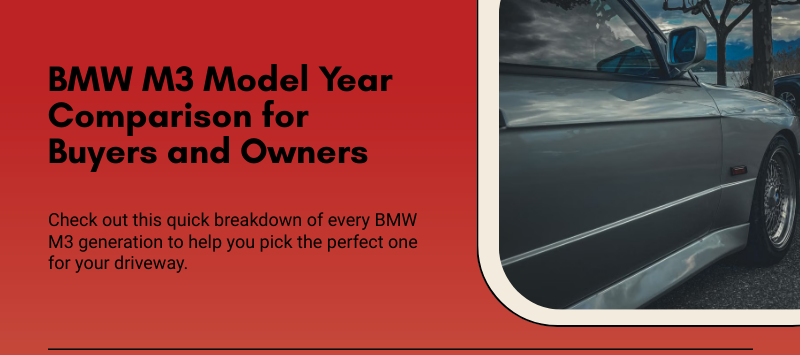
BMW M3 Model Year Comparison for Buyers and Owners
The best BMW M3 model year depends on how you intend to use the car. The E36 offers a relatively simple, analog ownership experience; the E46 adds a celebrated high-revving straight-six; the E9x is the only V8 M3; the F80 delivers turbocharged torque with a compact sedan footprint; and the G80 is the most versatile modern performer, including available all-wheel drive. The E30 remains a collector-oriented choice where condition and originality usually matter more than acceleration numbers. This comparison covers U.S.-market cars, since international models often used different engines and power ratings.
BMW M3 Model Years at a Glance
| U.S. years / chassis | Engine | Factory U.S. power | Primary attraction |
|---|---|---|---|
| 1988–1991 E30 | 2.3L S14 inline-four | 192 hp | Motorsport-era collectible |
| 1995–1999 E36 | 3.0L S50 / 3.2L S52 inline-six | 240 hp | Analog, comparatively simple |
| 2001–2006 E46 | 3.2L S54 inline-six | 333 hp | High-revving engine and handling |
| 2008–2013 E9x | 4.0L S65 V8 | 414 hp | Unique naturally aspirated V8 |
| 2015–2018 F80 | 3.0L S55 twin-turbo inline-six | 425 hp; 444 Competition | Turbo performance and daily usability |
| 2021–present G80 | 3.0L S58 twin-turbo inline-six | 473–523 hp, variant-dependent | Modern technology and available xDrive |
Power ratings refer to representative U.S. factory specifications, not special editions or international versions. For the 2025 and currently listed 2027 G80 configurations, the manual M3 makes 473 hp, the rear-drive Competition 503 hp and the Competition xDrive 523 hp.
How the M3 Changed Across Six Generations
The M3 began as a lightweight touring-car homologation project. With the E36, BMW shifted toward a road-focused six-cylinder coupe and sedan. The E46 refined that formula with the S54, while the E9x introduced an 8,300-rpm, 414-hp V8 to North American buyers. The F80 then exchanged naturally aspirated response for turbocharged low- and midrange torque. The G80 adds more electronic configuration, greater output and, in Competition xDrive form, all-wheel-drive traction.
That evolution affects ownership as much as performance. Older M3s demand careful attention to age-related deterioration and previous repairs. Newer ones carry additional thermal, electronic and drivetrain systems. A complete service history is therefore more informative than the odometer alone.
E30 M3 (1988-1991): The Motorsport Original
The E30 M3 is the correct choice for collectors who value steering feel, period-correct engineering and motorsport history over modern acceleration. U.S. cars use the 2.3-liter S14 four-cylinder, rated at 192 hp. BMW developed the original M3 for touring-car competition; its distinctive bodywork is part of the car's purpose, not merely cosmetic.
For buyers, the critical distinction is provenance rather than a late-versus-early-year performance claim. Inspect corrosion-prone body areas, evidence of accident repairs, suspension pickup points, engine compression, oil leaks and the availability of documented S14 specialist maintenance. A poorly restored E30 can require considerably more work than a clean example with higher mileage.
Owners should prioritize cooling-system integrity, ignition and fuel delivery, rubber components and correct replacement parts. Alterations that improve track usability can reduce appeal to originality-focused collectors. For a street-driven E30, a thorough baseline inspection is generally a better first investment than performance upgrades.
E36 M3 (1995-1999): The Analog Six-Cylinder
The U.S. E36 M3 is often the most straightforward route into classic M3 ownership. The 1995 model used the 3.0-liter S50, while the 1996–1999 models switched to the 3.2-liter S52. Both were rated at 240 SAE horsepower for the U.S. market. Those outputs should not be confused with the more powerful European S50 variants.
The year choice matters for emissions and engine-management systems as well as displacement. A buyer deciding between a 1995 car and a later example should assess local emissions requirements, the availability of familiar diagnostic tools and the quality of prior maintenance rather than selecting the 3.2-liter car on displacement alone.
Cooling-system plastic components, radiator condition, expansion hardware, hoses and thermostat operation deserve attention. Inspect rear suspension mounting points, bushings, steering components and previous collision repairs. Evidence of overheating or improvised repairs is a stronger warning sign than the absence of a particular option.
Choose an E36 when mechanical accessibility and balanced rear-wheel-drive dynamics matter more than outright speed. A stock, well-documented example is usually a better ownership proposition than a heavily modified car without a clear maintenance trail.
E46 M3 (2001-2006): The High-Revving S54
The E46 M3 introduced the 3.2-liter S54 engine to the U.S. M3 with 333 hp, a substantial step above the U.S. E36. The model combines compact proportions with an engine that rewards high rpm. Available configurations included a six-speed manual and the sequential manual gearbox, commonly called SMG; the latter is an automated manual rather than a conventional torque-converter automatic.
What changes between E46 model years?
Early-production and later-production E46s should not be treated as mechanically identical, but the decisive questions are tied to build date, documented service actions and maintenance, not simply the model-year badge. Early engines were subject to BMW connecting-rod-bearing-related service activity; verify campaign applicability and completion from the VIN and service records. A completed campaign is not a substitute for assessing current engine condition.
The E46's rear axle carrier mounting area requires a careful structural inspection for cracks, separation and evidence of previous reinforcement or repair. Buyers should also review VANOS service history, valve-clearance maintenance, cooling-system work and differential noise. For SMG cars, evaluate pump operation, fault records and shifting behavior rather than assuming all symptoms require the same repair.
A manual E46 with documented specialist maintenance is a compelling driver's car. An SMG example may also be a good purchase when its equipment and repair history are understood, but the transmission system changes the diagnostic and ownership equation.
Manual or SMG on an E46
BMW offered the E46 M3 with a six-speed manual or a six-speed SMG, operated by steering-wheel paddles or the centre-console lever. A limited-slip differential was standard. The SMG is an automated manual: it uses a conventional clutch actuated hydraulically rather than a torque converter, and it cannot skip gears. That distinction matters at inspection, because SMG symptoms can originate in the hydraulic pump, the accumulator, the clutch itself or the control software, and those are different repairs.
Buyers researching the E46 will also encounter the CSL. That car was a lighter, 360-hp European variant and was not sold new in the United States, so a U.S. listing describing a car as a CSL warrants particular scrutiny of what has actually been changed.
E90/E92/E93 M3 (2008-2013): The Only V8 Generation
The fourth-generation M3 brought the 4.0-liter S65 V8 to U.S. buyers, producing 414 hp at 8,300 rpm and 295 lb-ft of torque at 3,900 rpm. The E90 sedan, E92 coupe and E93 retractable-hardtop convertible appeal to different owners: the sedan adds practicality, the coupe offers the familiar two-door shape and the convertible prioritizes open-air driving.
The transmission decision is especially important. The six-speed manual favors driver involvement; the seven-speed dual-clutch transmission offers fast automated shifts but needs its own operating checks and service review. Body style also changes weight and complexity, so compare the condition and intended use of each vehicle rather than treating them as interchangeable.
S65 rod-bearing wear and throttle-actuator faults are established enthusiast inspection topics, but an individual vehicle cannot be diagnosed by reputation. Ask for maintenance documentation and any specialist test results. During inspection, review fault history, oil leaks, engine operating temperature, cooling-system performance, idle quality and evidence of previous high-temperature use.
The E9x is the best fit when the naturally aspirated V8 experience is central to the purchase. It is a poor match for someone expecting ordinary 3 Series maintenance economics; the engine's specialized parts and service requirements need to fit the ownership budget.
F80 M3 (2015-2018): Turbocharged Torque in a Sedan
The F80 was a major change in character. BMW replaced the naturally aspirated V8 with the 3.0-liter twin-turbo S55 inline-six, and the M3 became sedan-only as coupe and convertible variants moved to the M4 name. The standard U.S. F80 was rated at 425 hp. The Competition Package, introduced in 2016, increased output to 444 hp and included suspension and chassis calibration changes.
Standard, Competition and CS versions
A standard F80 makes sense for a daily driver who wants strong acceleration without prioritizing the sportiest factory specification. The Competition Package merits consideration for buyers who value its suspension tuning, equipment and factory power increase. The limited-run CS is more specialized and should be evaluated with attention to authenticity, condition and component replacement cost.
It is worth knowing what the package actually changed, because sellers often use the word loosely. BMW listed retuned Adaptive M Suspension with new springs, dampers and anti-roll bars; reconfigured Comfort, Sport and Sport Plus modes; a recalibrated Active M Differential and stability system; forged 20-inch wheels in a staggered fitment with 265/30 front and 285/30 rear tires; lightweight M sports seats; and an M sports exhaust. The package reached buyers from spring 2016. Confirm the equipment against the build record rather than the listing text, and check tire sizes and wear across the staggered fitment at inspection.
For any F80, confirm whether the engine-control software, intake, downpipes or turbocharger hardware have been modified. A tune does not prove damage, but it changes how the engine and drivetrain should be evaluated. Examine cooling-system performance, oil leaks, charge-air plumbing, misfire history, clutch or dual-clutch behavior and tire wear.
The F80 is one of the strongest candidates for an enthusiast who wants a usable older M3 with considerable acceleration. Its appeal depends heavily on how the previous owner used and maintained it, especially if it has accumulated track or high-output modified use.
G80 M3 (2021-Present): Manual, Competition and xDrive
The G80 M3 uses the 3.0-liter twin-turbo S58 inline-six. Its defining buyer decision is drivetrain and transmission rather than generation alone. The base M3 offers a six-speed manual and rear-wheel drive. The Competition uses an eight-speed automatic, and Competition xDrive adds all-wheel drive. Current BMW USA listings identify 473 hp for the manual, 503 hp for rear-drive Competition and 523 hp for Competition xDrive.
The 2025 update and later model years
For model year 2025, BMW increased Competition xDrive output by 20 hp to 523 hp, while the manual M3 and rear-drive Competition remained at 473 and 503 hp. The 2025 update also brought refreshed lighting and steering-wheel details, plus BMW Operating System 8.5. A 2025-plus xDrive is therefore meaningfully different from an earlier version, but a newer year does not automatically outweigh condition, options or prior use.
The visual and interior changes are easy to use as a quick identifier. The 2025 car carries redesigned LED headlights that combine low and high beam in a single module, with two vertical LED elements serving as daytime running lights and turn signals; a redesigned three-spoke M leather steering wheel with a flat-bottomed rim and a red centre marker; new forged wheels; and BMW Operating System 8.5 on the curved display. If a listing photograph shows the earlier wheel and the earlier lights, the car is a pre-update example whatever the advertisement says.
When shopping for a G80, decide first whether a manual gearbox is nonnegotiable. If so, the rear-drive base model is the straightforward choice. Buyers seeking repeatable acceleration and all-weather traction should evaluate Competition xDrive, while drivers wanting the automatic without additional all-wheel-drive hardware may prefer rear-drive Competition.
Check brake and tire condition, cooling-system faults, drivetrain error history, sensor operation, software update status and any evidence of track use. For cars still under factory coverage, confirm the warranty status and maintenance history rather than assuming a modification or aftermarket tune is covered.
Are There BMW M3 Years to Avoid?
This is the most common question asked about the M3, and the honest answer is that it is the wrong unit of analysis. No M3 model year is uniformly bad, and none is uniformly safe. Within every generation, individual cars differ far more than consecutive model years do.
What genuinely varies with the calendar is narrow and checkable. The E36 changed displacement and engine management between the 1995 S50 car and the 1996-1999 S52 cars. Early E46 production fell within BMW connecting-rod-bearing service activity, which is confirmed by VIN and service record rather than by year alone. The F80 gained the Competition Package from spring 2016. The G80 Competition xDrive gained 20 hp for 2025 alongside the lighting, wheel and operating-system changes. Everything else that separates two M3s of the same generation comes from how the car was used, maintained and repaired.
So rather than ruling out a year, rule out a car. Ask for invoices instead of a summary, confirm campaign applicability and completion against the VIN, have every module scanned for stored and pending codes, and get a generation-specific pre-purchase inspection before money changes hands. A well-documented example from a "bad" year is a better purchase than an undocumented one from a celebrated year.
M3 or M4: What Changed in 2015
Shoppers moving between listings from before and after 2015 often find the body styles confusing, and it affects which search terms return the car they actually want.
Through the E9x generation, the M3 was sold as a sedan (E90), a coupe (E92) and a retractable-hardtop convertible (E93). From the F80 generation, BMW split the names by body style: the M3 became the sedan, and the coupe and convertible took the M4 name. The G80 M3 continues as a sedan. A shopper who wants a two-door car of F80-era vintage is therefore looking for an M4, not an M3, even though the two share their engine and much of their running gear.
For a buyer, the practical consequences are body-style ones: weight, rear-seat access, structural rigidity on the convertible and the size of the used pool. The mechanical inspection priorities for an F80 M3 and a contemporary M4 are substantially the same, because the S55 powertrain is shared.
Transmission Choices by Generation
For many buyers the gearbox matters more than the generation, and it narrows the search quickly. It also changes what a transmission inspection needs to cover.
The E46 offered a six-speed manual or the six-speed SMG automated manual. The E9x offered a six-speed manual or a seven-speed dual-clutch transmission. The F80 offered a six-speed manual or a seven-speed dual-clutch. On the G80, the six-speed manual is confined to the rear-drive base car, while the Competition and Competition xDrive use an eight-speed automatic.
Three of those are not interchangeable at inspection. A conventional manual is assessed on clutch wear, engagement and synchromesh. An automated manual such as SMG adds a hydraulic system with its own pump, accumulator and calibration. A dual-clutch transmission has its own fluid service history, mechatronic unit and adaptation behaviour. Ask which of the three the car has before agreeing what the inspection will cover.
Which BMW M3 Should You Buy?
| Buyer profile | Best starting point | Trade-off |
|---|---|---|
| Collector | E30 | Originality and specialist restoration requirements |
| Analog weekend driver | E36 or E46 manual | Age and maintenance documentation |
| Naturally aspirated engine enthusiast | E9x V8 | Specialized engine upkeep |
| Fast used daily driver | F80 | Modification history and ride preference |
| Modern daily driver with manual | G80 base | Rear-wheel drive only |
| Maximum factory traction | G80 Competition xDrive | Higher drivetrain complexity |
These are use-case recommendations, not statistically derived reliability rankings. Across generations, a well-maintained example with a complete repair history can be a better decision than a theoretically more desirable year with undisclosed problems.
What to Inspect Before Buying a Used BMW M3
An M3 pre-purchase inspection should be generation-specific and performed by a technician familiar with BMW M systems. A generic inspection focused only on fluid levels and dashboard lights may overlook the most expensive areas of uncertainty.
- Confirm VIN, original drivetrain configuration, title history, open recalls and the presence of factory or aftermarket modifications.
- Obtain service invoices, not only a maintenance summary. Look for documented oil service, cooling-system work, transmission service and previously repaired faults.
- Perform a cold-start and full operating-temperature assessment. Scan all relevant control modules and investigate stored or pending codes.
- Inspect the underside for structure, bushings, suspension play, fluid leaks, corrosion and collision repair evidence.
- Check tires and brakes against the intended use. Uneven wear can reveal alignment, suspension or driving-history issues.
- For generation-specific engines, discuss compression or leak-down testing and any additional tests justified by condition and symptoms.
Check U.S. recall applicability using the NHTSA VIN lookup. A service bulletin, manufacturer campaign and safety recall are different categories; repair eligibility should not be assumed from an online discussion alone.
Maintaining a BMW M3 in Dallas and Plano
North Texas heat makes cooling and air-conditioning performance relevant to daily use, especially in stop-and-go traffic. Inspect radiators, fans, expansion components, coolant leaks and previous overheating complaints. Heat alone does not establish that a given M3 engine is defective; age, maintenance, driving conditions and condition of individual components matter.
Performance tires also require closer attention than many owners expect. Confirm the manufacturer-specified sizes and load ratings, monitor pressure as temperatures change, and check tread depth and alignment before extended highway trips. Owners who track their cars should follow the appropriate high-load inspection and fluid-service guidance for their specific model and use.
For Dallas and Plano owners, a specialist familiar with E36 through G80 hardware can help distinguish a generation-specific concern from an ordinary wear item. Maintenance decisions should follow vehicle inspection findings, BMW service information and the owner's usage rather than a blanket list of internet-reported faults.
Routine work matters more on these cars than on an ordinary 3 Series, because the M engines are less tolerant of deferred service. Keep oil service on schedule for the specific engine, and treat any change in operating temperature, oil consumption or idle quality as a reason to investigate rather than to wait.
How the Next M3 Buying Decision Will Change
As G80 cars age, service records for their electronic systems, software changes and drivetrain components will become more important in used-car comparisons. At the same time, originality and documented preventive maintenance will continue to separate appealing E30, E36, E46 and V8 examples from cars that merely share the same model-year designation.
BMW M3 Model Year Questions
Which BMW M3 generation is the most reliable?
No generation is reliable or unreliable as a class. Condition, maintenance history and previous use separate good cars from poor ones far more than the chassis code does. The E36 and the G80 are mechanically the most straightforward to live with at opposite ends of the range, the E36 because it is simple and the G80 because it is new, but a neglected example of either will demand more work than a well-kept car from any other generation.
Which M3 is the only one with a V8?
The E90 sedan, E92 coupe and E93 convertible, sold from 2008 to 2013, are the only M3s with a V8. The engine is the 4.0-liter S65, rated at 414 hp at 8,300 rpm for the U.S. market. Every other generation used an inline-four or an inline-six.
What is the difference between the M3 and the M4?
From the F80 generation onward, BMW uses M3 for the sedan and M4 for the coupe and convertible. Before that, the M3 name covered all three body styles. The cars share engines and most running gear within a generation, so the difference is body style rather than mechanical specification.
Can you still get a BMW M3 with a manual gearbox?
Yes. On the current G80, the six-speed manual is offered on the rear-wheel-drive base M3, which BMW USA lists at 473 hp. The Competition and Competition xDrive use an eight-speed automatic, so a manual car is necessarily rear-wheel drive.
What changed on the 2025 BMW M3?
BMW raised Competition xDrive output by 20 hp to 523 hp, while the manual M3 stayed at 473 hp and the rear-drive Competition at 503 hp. The update also brought redesigned LED headlights, a new three-spoke M steering wheel, new forged wheels and BMW Operating System 8.5.
Is the E46 M3 SMG transmission worth avoiding?
Not automatically. SMG is an automated manual rather than a conventional automatic, and it adds a hydraulic pump, accumulator and control software to the inspection list. An SMG car with documented work and normal shifting behaviour can be a sound purchase; the point is to evaluate the system specifically rather than assume every symptom has the same cause or the same repair.
How do I check whether an M3 has an open recall?
Run the vehicle identification number through the NHTSA recall lookup. Note that a technical service bulletin, a manufacturer campaign and a safety recall are different things, and eligibility for a free repair should be confirmed through the VIN rather than assumed from an online discussion.
Does North Texas heat affect which M3 I should buy?
It affects what you inspect more than which generation you choose. Cooling and air-conditioning performance matter in stop-and-go traffic here, so radiators, fans, expansion components and any history of overheating deserve attention on any M3. Heat alone does not establish that a particular engine is defective.
Bring the VIN, the service invoices and the listing. A generation-specific inspection answers what the model year cannot, whether you are buying an E36 or a G80.
Dallas - White Rock and Plano locations are listed on the contact page.Sources
- BMW M. The BMW M3 Generations at a Glance. 2026. bmw-m.com
- BMW M. The BMW M3 E30. 2020. bmw-m.com
- BMW M. BMW M3 E36. 2020. bmw-m.com
- BMW M. The BMW M3 E46. 2020. bmw-m.com
- BMW Group. 2008 M3 Coupe and Sedan North American Debut. 2007. press.bmwgroup.com
- BMW Group. New Competition Package Amps Up the BMW M3 and M4. 2016. newsroom.bmwgroup.com
- BMW Group. The New 2025 BMW M3. 2024. newsroom.bmwgroup.com
- BMW USA. M3 Sedan Model Overview and Specifications. Accessed November 2026. bmwusa.com
- NHTSA. Vehicle Safety Recall Lookup. nhtsa.gov
- BMW M. Legendary Engines from BMW M. 2024. bmw-m.com