
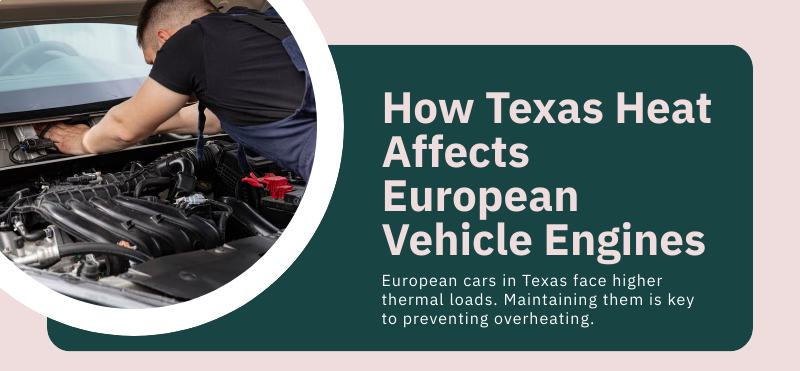
Dallas–Fort Worth averages 20 triple-digit days per year. A severe season can produce 55. That does not overwhelm a healthy vehicle — but it leaves no margin for a weak fan, restricted heat exchanger, aging battery, or incorrect fluid.
Texas heat should not make a properly maintained European vehicle overheat. It raises the thermal load on the radiator, charge-air cooler, engine oil, transmission cooling, air-conditioning condenser, fans, pumps, and electrical system. Heat-related trouble usually appears when high ambient temperature combines with reduced airflow, sustained engine load, a degraded component, or an incorrect service condition.
Texas Heat Changes Cooling Reserve, Not the Engine's Basic Job
A cooling system regulates temperature — it does not try to keep the engine cold. Coolant absorbs combustion heat, circulates through heat exchangers, and transfers that heat to outside air. As ambient temperature rises, the temperature difference between hot coolant and ambient air becomes smaller, so rejecting the same amount of heat requires more airflow, heat-exchanger capacity, or fan and pump output.
North Texas driving can combine several demands simultaneously. Slow traffic reduces ram air through the grille. The air conditioner adds heat at the condenser, which is often positioned ahead of the radiator. Turbochargers raise intake-air temperature under boost. A heavy SUV or performance sedan accelerating repeatedly generates more heat than the same vehicle cruising steadily.

European vehicles are not designed only for mild climates. Porsche's climatic wind tunnel can reproduce ambient temperatures from −30°C to 50°C (−22°F to 122°F), along with solar radiation, humidity, wind, towing load, and stop-and-go operation. Extreme-weather validation establishes what a new, correctly functioning vehicle can manage — it does not compensate for heat cycles, debris, seepage, incorrect fluid, or deferred maintenance.
European Vehicle Engines Do Not Share One "Texas Heat Problem"
The useful distinction is thermal architecture, not nationality. Two vehicles from the same manufacturer may have different engine locations, cooling circuits, airflow paths, pumps, thermostat strategies, and oil requirements. A correct inspection begins with the VIN, model year, engine code, drivetrain, software level, and modification history.
| Vehicle or Engine Pattern | Heat-Sensitive Areas | Why It Matters |
|---|---|---|
| Compact turbocharged engine | Charge-air cooling, turbo oil and coolant lines, electric pumps, crowded heat exchangers | High output from a small package concentrates heat — airflow management is critical |
| High-output performance or luxury engine | Multiple radiators, oil cooling, transmission cooling, after-run pumps, active airflow controls | A partial failure may first appear as reduced power or a stored thermal fault, not an overheat warning |
| Older naturally aspirated engine | Hoses, expansion tank, radiator seams, thermostat, fan clutch or electric fan, water pump | Age-related loss of pressure or circulation often matters more than the engine's original output |
| Plug-in hybrid with a combustion engine | Engine circuit, battery and power-electronics circuits, shared frontal airflow, electric pumps and valves | Several systems can compete for airflow and reject heat through separate temperature zones |
| Rear- or mid-engine vehicle | Distributed radiators, long coolant paths, side or front intakes, specialized bleeding procedures | A leak, trapped air, or blocked intake may be far from the engine itself |
Audi, Mercedes-Benz, BMW, Porsche, Jaguar, Bentley, Land Rover, MINI, and Rolls-Royce all have vehicles that fit more than one of these patterns. Brand familiarity helps — model-specific service information is what identifies the correct fill procedure, approved coolant, oil specification, test plan, and operating thresholds.
Seven Systems That Lose Margin in Triple-Digit Weather
Driving Conditions Provide Better Clues Than a Parts List
The moment a symptom appears can narrow the diagnostic path considerably. These patterns are clues, not proof — several faults can produce similar behavior.
The patterns below are diagnostic starting points — not confirmed causes. Modern control modules preserve fault codes, freeze-frame temperatures, and fan commands even after a warning clears. Clearing codes before documenting them removes the context needed to identify the actual cause.
Normal Heat Management vs. Warning Signs
A louder fan in traffic, a longer fan run after heavy use, or slightly less repeatable acceleration on a very hot afternoon can be normal system behavior. Protective strategies may alter boost, torque, transmission behavior, or air-conditioning output to maintain safe temperatures.
Inspection is justified when the behavior is new, severe, or persistent — or when any of the following occur:
A Texas Summer Inspection Should Prove the System Can Work Under Load
A useful inspection does more than verify that the reservoir contains fluid. It establishes whether the vehicle can circulate coolant, retain pressure, move air, control each thermal circuit, and maintain voltage under demand.
Four Hot-Weather Fixes That Often Create New Problems
Installing thicker oil without checking the approval
A higher viscosity is not automatically safer. An unapproved oil can conflict with cold-flow, turbocharger, emissions-system, fuel-economy, or variable-valve-control requirements. The correct manufacturer approval and performance specification must both match.
Treating coolant color as a specification
Similar colors do not prove chemical or manufacturer compatibility. Use the specification and procedure assigned to the exact vehicle — mixing incompatible coolants can cause gel formation and corrosion.
Adding coolant repeatedly without finding the loss
A sealed cooling system should not require routine top-offs. Continued loss can introduce air, reduce reserve, and allow a small defect to become a roadside failure. Repeated topping-off is evidence, not a repair.
Buying cooling upgrades before confirming baseline
Larger radiators or aftermarket coolers cannot correct a weak pump, incorrect bleeding, missing duct, bad sensor, obstructed condenser, or underperforming fan. Verify the existing system is complete and functional first.
What to Do When a Temperature Warning Appears
Reduce engine load and follow the vehicle's displayed instructions. If the message directs the driver to stop, pull over safely and shut the engine down. Do not open a hot or pressurized coolant reservoir — escaping steam and coolant can cause serious burns. Do not continue driving through a persistent temperature warning simply because the vehicle still moves.
Record the outside temperature, traffic condition, speed, load, A/C use, warning text, gauge position, and whether power changed. That context can make an intermittent problem reproducible and eliminates the need for guesswork.
If there is active leakage, steam, repeated coolant loss, or a stop-engine warning, the safer next move is transport rather than another drive cycle. A cleared display does not prove the cause is gone.
European Vehicle Summer Inspection in Dallas and Plano
Factory-trained technicians. European factory diagnostic tools. A complete heat-load inspection — not just a fluid check — backed by a 3-year/36,000-mile labor warranty.
Frequently Asked Questions
Are European cars more likely to overheat in Texas?
Not simply because they are European. A healthy vehicle is designed for hot climates. Risk is driven more by cooling-system condition, engine architecture, airflow, age, load, and service history than by country of origin.
Is 100°F too hot for a European vehicle engine?
No. Triple-digit ambient temperature is within the conditions a properly functioning modern vehicle should manage. It leaves less reserve, so a marginal fan, pump, heat exchanger, seal, or battery may become noticeable under conditions that would not stress a fully healthy system.
Why does my vehicle run hotter in traffic than on the highway?
Highway motion forces more air through the cooling stack. At low speed, the vehicle depends heavily on electric fans, shutters, ducts, and clean heat exchangers. A weakness in any of those areas often appears first in stop-and-go conditions rather than at highway speeds.
Can air-conditioning use make an engine overheat?
Air conditioning adds heat at the condenser and increases electrical and mechanical demand. It should not overheat a healthy vehicle, but it can expose inadequate airflow or cooling capacity that is not apparent in milder conditions.
Should I use thicker oil during a Texas summer?
Not unless the vehicle manufacturer permits that viscosity for the exact engine and operating conditions. Match the required viscosity, manufacturer approval, and oil performance specification — a higher viscosity is not automatically safer and can conflict with other requirements.
Why does my European vehicle lose power when it is hot?
The engine or transmission controller may reduce torque when intake air, coolant, oil, transmission fluid, or another monitored system exceeds its target. This is a protective response — but persistent or severe reduction requires diagnosis rather than assuming it is normal heat soak.
Can I drive after a temperature warning goes away?
A cleared display does not prove the cause is gone. Review the owner's instructions and have recurring warnings or coolant loss diagnosed before normal driving resumes. If the warning message instructs the driver to stop or reduce speed, follow the vehicle's instruction.
- National Weather Service Fort Worth/Dallas, "DFW — Normals, Means, and Extremes," 1991–2020 climate normals. weather.gov
- National Weather Service Fort Worth/Dallas, "DFW — 100° Day Data," updated 2026. weather.gov
- Porsche Newsroom, "How the Climatic Wind Tunnel in Weissach Works," 2024. newsroom.porsche.com
- Audi of America, "Tech Talk: The 2020 Audi S6 and S7 2.9-Liter V6 TFSI Engine and Electric-Powered Compressor," 2020. media.audiusa.com
- American Petroleum Institute, "API's Motor Oil Guide," 2025. api.org
- AAA Mountain West Group, "How to Prevent Heat Damage to Your Car Battery," updated 2026. mwg.aaa.com
- BMW of North America, "2025 BMW Maintenance," 2025. bmwusa.com