
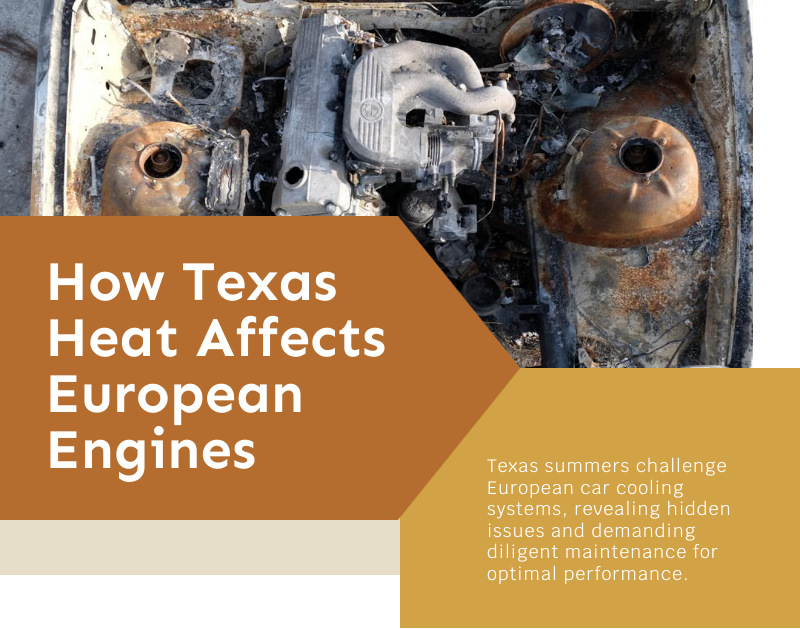
European engines are engineered for demanding temperature ranges, but a North Texas summer can expose weaknesses that remain invisible in milder climates. When the air outside is already near or above 100°F, a cooling-system leak, restricted airflow or weakening battery becomes a different kind of problem.
Texas heat affects European engines by reducing the temperature difference between the engine and the surrounding air. That makes it harder for the radiator, intercooler, engine oil and air-conditioning system to release heat. In a BMW M3, the effects become most noticeable during traffic, repeated acceleration, track use or any condition that combines high engine load with limited airflow.
- Why Texas Heat Reduces Cooling Margin
- European Performance Engines and Heat
- How the G80 M3 Manages Heat
- Warning Signs That Justify Inspection
- Five Areas to Watch This Summer
- Street, Track and Tuned Use Patterns
- How Heat Affects M3 Generations Differently
- What a Summer Inspection Should Cover
- Frequently Asked Questions
Texas Heat Reduces an Engine's Cooling Margin
A cooling system does not simply keep the engine cold. It regulates the engine within a controlled operating range while carrying excess heat away through coolant, engine oil and moving air. Heat transfer becomes more difficult as ambient temperature rises. Coolant entering a radiator on a 70°F day has a much greater temperature difference from the surrounding air than it does when the outside temperature is 105°F. The system must therefore work harder to reject the same amount of engine heat.
This is not an occasional problem in Dallas-Fort Worth. Individual summers can be considerably harsher than the long-term averages. A healthy vehicle accounts for these conditions. Trouble usually begins when Texas heat combines with a second problem — a weak fan, partially obstructed radiator or slow coolant leak.
A healthy vehicle handles each of these conditions. Problems emerge when heat combines with a second issue — a weak fan, restricted heat exchanger or slow coolant leak.
Why European Performance Engines Require Precise Heat Management
European engines are not inherently incapable of handling hot weather. The meaningful difference is that many modern European vehicles use compact engine compartments, turbocharging, direct injection, complex electronic controls and multiple thermal circuits to deliver high output with everyday drivability. That engineering creates precise temperature-control requirements.
A modern BMW may regulate engine coolant, charge air, engine oil, transmission fluid, turbochargers and cabin climate through interconnected but distinct systems. A fault in one circuit may affect performance before the dashboard displays an obvious warning.
| System | Effect of Extreme Heat | Possible Driver Observation |
|---|---|---|
| Engine coolant | Less efficient heat rejection | Fan running often, rising temperature or warning |
| Charge-air cooling | Higher intake-air temperature | Less consistent power under repeated acceleration |
| Engine oil | Lower viscosity at elevated temp | Greater dependence on correct level and specification |
| Turbochargers | Increased bearing and oil-line heat | Heat-soak effects after sustained load |
| Cooling fans | Longer operating periods | Loud fan at low speed or weak cooling in traffic |
| Battery and electronics | Faster deterioration, higher demand | Slow starting, low-voltage faults, intermittent warnings |
| Rubber and plastic parts | Accelerated aging over heat cycles | Seepage, brittle connectors, hose deterioration |
| Air conditioning | Higher refrigerant and condenser load | Weak cooling at idle or peak afternoon temperatures |
The concern is not simply the peak temperature recorded on one afternoon. Repeated heating and cooling cycles gradually stress seals, plastic fittings, expansion tanks, hoses and electrical connections. Age and mileage remain important, but climate can influence when an already weakened component becomes noticeable.
The BMW M3 Is Engineered for Heat — Within a Healthy System
The current G80-generation BMW M3 uses a 2,993 cc S58 inline-six engine with two mono-scroll turbochargers and indirect charge-air cooling, producing between 473 and 523 horsepower depending on configuration. BMW equipped this platform with considerably more thermal capacity than a standard 3 Series: high- and low-temperature radiators, a dedicated engine-oil cooler, large front air openings and, on Competition models, a separate transmission-oil cooler.
The S58's water-to-air intercooler, integrated near the intake plenum, provides approximately 50% more cooling performance than the system used with the previous S55 engine. These features make the M3 highly capable — but they do not make maintenance optional. A complex cooling system has more than one coolant circuit, heat exchanger, pump, sensor and airflow path to evaluate.
The G80 M3 has two main coolant circuits. Inspecting only the main radiator can miss a charge-air circuit issue that is already affecting performance.
Warning Signs That Justify Inspection
Normal heat management in an M3 — a loud fan after hard driving, an adjusted boost map, engine protection responses — is not overheating. These are the system working as designed. The signs below go beyond normal and warrant a call to an Autoscope BMW specialist.
A warning should not be dismissed simply because the temperature later returns to normal. BMW control modules store fault information, operating conditions and temperature-related events that help distinguish a temporary protective response from a developing failure. Autoscope uses BMW ISTA and ISID to read this data at both its Plano and Dallas locations.
Five Areas M3 Owners Should Watch During a Texas Summer
A small coolant loss matters more when the cooling system is under sustained summer load. The source may be a hose connection, expansion tank, radiator, water pump, heat exchanger or another sealed-system component. Checking the reservoir when the engine is cold can reveal a declining level, but repeatedly adding coolant does not solve the leak.
The system should be inspected and pressure-tested if the level continues to fall. BMW lists coolant level among the items owners should check regularly. Service decisions should follow the model's documentation, fluid condition and repair history. Never open a pressurized coolant reservoir while the engine is hot.
The M3 depends on clear airflow through several front-mounted heat exchangers. Leaves, road debris, bent fins, dirt and improperly installed aftermarket components can restrict that path. Airflow deserves particular attention when a vehicle behaves normally at highway speed but becomes hot in traffic — that pattern can point toward a fan-control problem or obstructed heat exchanger.
The front underbody should also be inspected after any impact. The G80 M3's low-mounted engine-oil cooler relies on directed airflow, and damage beneath the front bumper may not be obvious from above.
Engine oil lubricates the M3's internal components, but it also carries heat away from the engine and turbochargers. Using the correct BMW-approved oil is more important than selecting a viscosity based on Texas temperature alone. The required specification can differ by model year, market and engine configuration — owners should follow the applicable owner's manual rather than assuming thicker oil automatically provides better hot-weather protection.
Track use, tuning and repeated short trips can also justify a maintenance discussion based on how the vehicle is actually driven rather than mileage alone. Autoscope's BMW technicians can confirm the right specification for your exact build.
The charge-air system has a separate job from the main engine-coolant circuit. It manages the temperature of the compressed air leaving the turbochargers. Hot ambient air gives the system a warmer starting point. After repeated acceleration, the intercooler circuit may retain more heat, producing higher intake-air temperatures — the engine-management system can then reduce output to protect against knock and excessive thermal load.
A repeatable or severe loss of power, stored faults or an inability to recover after normal driving deserves diagnosis. The inspection should include pumps, coolant level, temperature sensors, heat exchangers and any recent modifications — not only the main radiator.
Heat is hard on automotive batteries even though cold weather often receives more attention. A weakening battery can create low-voltage faults across a modern BMW's interconnected modules. The additional summer demand from cooling fans, cabin blowers and repeated A/C use can make an existing weakness more apparent.
Electric cooling fans and pumps also need to respond at the commanded speed. A component may still operate but fail to deliver its expected output under maximum load. BMW-specific diagnostic software can compare commands, actual values and stored faults more effectively than a basic code reader — which is why Autoscope runs ISTA and ISID at both locations.
Street Driving, Track Use and Tuning Create Different Heat Loads
A stock M3 used for commuting does not have the same thermal requirements as a tuned car making repeated high-boost pulls or running extended track sessions. Understanding which category applies guides the right pre-summer inspection.
Daily Commuting
Primary concern: traffic airflow, coolant integrity and A/C load. Inspect leaks, fans, heat exchangers and fluid levels.
Spirited Street Driving
Primary concern: repeated boost and charge-air temperature. Confirm charge-air circuit operation and unobstructed airflow.
Track Use
Primary concern: sustained oil, coolant, transmission and brake temperature. Complete pre-event inspection and post-event fluid review.
Tuned Engine
Primary concern: greater heat production under boost. Confirm that the cooling strategy matches the calibration and use pattern.
A cooling upgrade is not automatically necessary for every Texas-driven M3. The factory G80 system is designed for substantial thermal demand. Before changing hardware, establish that the stock system is full, properly bled, unobstructed and operating as designed. Modified vehicles require a different calculation — cooling changes should be selected as part of the complete build, not treated as a cosmetic upgrade.
Texas Heat Affects M3 Generations Differently
"M3 cooling problem" does not describe one uniform issue. Each generation uses a different engine architecture and heat-management strategy. Age can be as important as engine design — an older M3 with a clean service history may still contain heat-cycled plastic, rubber or electrical components.
Age can be as important as engine design. A G80 with debris-blocked coolers or an improperly bled circuit needs the same attention as an E46 with aging coolant hoses.
What a Summer Inspection Should Establish
A productive hot-weather inspection goes beyond confirming that coolant is present. It should determine whether the entire system can maintain control under realistic load. Autoscope's BMW service uses ISTA and ISID diagnostic systems at its Plano and White Rock locations, backed by more than 40 years of European-car experience and the Autoscope Assurance® — a 3-year/36,000-mile labor warranty on all work performed.
A complete summer evaluation for a BMW M3 may include:
- Checking all fluid levels when the engine is cold
- Inspecting for dried coolant residue and slow seepage
- Pressure-testing the cooling system when indicated
- Examining the radiator, auxiliary heat exchangers and oil cooler
- Verifying electric fan and coolant-pump operation at commanded speed
- Reading BMW-specific fault memory and temperature data via ISTA
- Confirming the correct oil specification and current level
- Checking the battery's condition and charging performance
- Inspecting underbody panels and airflow guides
- Reviewing modifications, tuning and actual vehicle use
- Road-testing under conditions likely to reproduce the complaint
A Texas-ready M3 is not one with unnecessary parts replaced before summer. It is one whose cooling, lubrication and electrical systems have been tested as a complete system, with any recommendation tied to evidence the owner can understand.
Summer BMW Service in Dallas and Plano
Autoscope's BMW-specialist technicians use factory ISTA and ISID diagnostics to evaluate your M3's cooling, oil, battery and electronic systems — before Texas heat finds the weak point first.
Frequently Asked Questions
Can Texas heat cause a BMW M3 to overheat?
Texas heat alone should not cause a healthy BMW M3 to overheat. It reduces the cooling system's available margin, however, so a leak, weak fan, failing pump, restricted heat exchanger or improper coolant fill may become apparent during hot weather that would not have surfaced in a milder climate.
Is loud fan operation normal on an M3 in summer?
A loud cooling fan can be normal after hard driving, in heavy traffic or with the air conditioner running at full demand. Sudden, constant or unusually frequent full-speed operation can also indicate a stored fault, an incorrect temperature reading or a cooling-system problem that warrants inspection.
Does a BMW M3 lose horsepower when it is hot outside?
Some reduction in repeatable performance can occur when hotter ambient air and heat-soaked charge-air components raise intake temperature. The engine-management system may reduce output to protect the powertrain. A slight difference on an exceptionally hot day is normal. Severe or persistent power loss should be diagnosed by a BMW specialist.
Should I use thicker engine oil in my M3 during a Texas summer?
Do not change viscosity solely because Texas is hot. Use an oil carrying the BMW approval and viscosity specified for the exact model year and engine configuration. Modifications or track use should be evaluated separately with a BMW specialist who can confirm the correct spec for your build.
Does the G80 M3 need an upgraded cooling system in Texas?
A stock, properly maintained G80 M3 generally does not need a cooling upgrade for ordinary road use. Track use, substantial power increases or repeated high-load driving may change the requirement — but the factory system should be confirmed to be full, properly bled and unobstructed before any hardware change is considered.
What should I do if my M3 displays a temperature warning?
Reduce load and follow the instructions displayed by the vehicle. If the warning indicates that the engine is too hot or instructs you to stop, pull over safely and shut the engine down. Do not open the coolant reservoir while the system is hot or pressurized. Have the system diagnosed before driving the vehicle again.
- National Weather Service Fort Worth/Dallas, "DFW — Normals, Means and Extremes," 1991–2020 climate normals. weather.gov
- National Weather Service Fort Worth/Dallas, "DFW — 100° Day Data," updated 2026. weather.gov
- BMW of North America, "BMW 3 Series Sedan M Models — Technical Data," accessed 2026. bmwusa.com
- BMW Group, "The New 2021 BMW M3 Sedan and M4 Coupe," 2020. press.bmwgroup.com
- BMW M, "BMW M3 and M4: Cooling System," 2025. bmw-m.com
- BMW of North America, "2025 BMW Maintenance," 2025. bmwusa.com
- Autoscope European Car Care, "BMW Mechanics in Dallas," accessed 2026. autoscopecarcare.com